
In Indian court case numbers, CRM stands for Criminal. It is a case-type code, not a full name. In the Punjab and Haryana High Court, for example, CRM-M means Criminal Main petition and CRM on its own means Criminal Miscellaneous application.
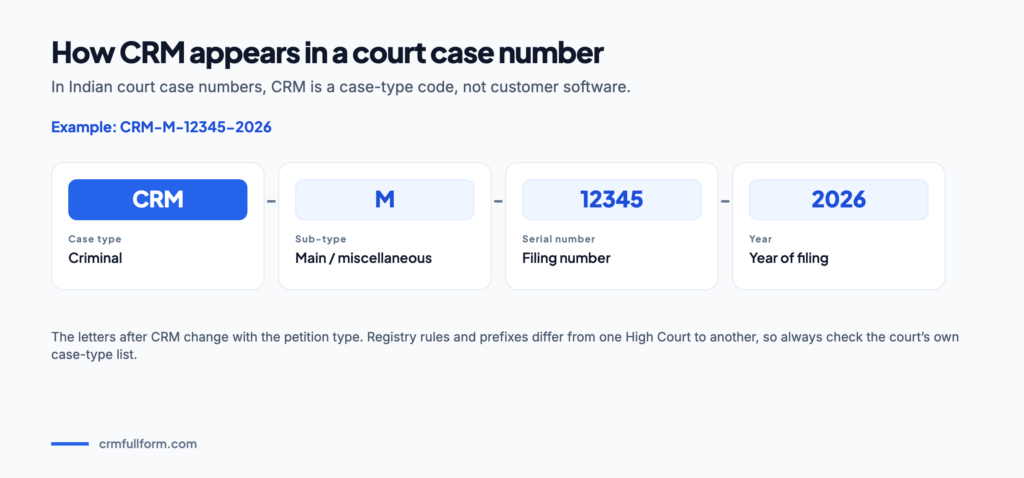
How a court case number is built
An Indian case number is made of three parts: a case-type code, a serial number and the year. A number such as CRM-M-12345-2025 reads as case type CRM-M, filing number 12345, year 2025. The letters at the front tell the registry — and anyone reading the cause list — what kind of matter it is.
| Part | Example | Meaning |
|---|---|---|
| Case type | CRM-M | Criminal Main petition |
| Number | 12345 | The serial number given at filing |
| Year | 2025 | The year the case was filed |
CRM case-type codes and what they mean
These codes are used in the Punjab and Haryana High Court, which is where most CRM searches come from. Other High Courts use their own lists, so always check the case-type table published by the court concerned.
| Code | Stands for | Typically filed for |
|---|---|---|
| CRM-M | Criminal Main | Main criminal petitions, such as bail petitions and petitions to quash an FIR or proceedings |
| CRM | Criminal Miscellaneous | An application filed inside an existing criminal case, for example to place documents on record or seek an exemption |
| CRM-A | Criminal Miscellaneous (Appeal) | An application seeking leave to appeal against an acquittal |
| CRA | Criminal Appeal | An appeal against a conviction or sentence |
| CRR | Criminal Revision | A revision petition against an order of a lower criminal court |
| CRWP | Criminal Writ Petition | A writ petition on a criminal matter, such as protection or custody issues |
What is a CRM-M petition?
CRM-M — Criminal Main — is the case type used for a criminal petition that stands on its own rather than sitting inside another case. The two most common uses are bail and quashing.
- Anticipatory bail — bail applied for before arrest, when a person fears arrest in a registered FIR.
- Regular bail — bail applied for after arrest, while the case is pending.
- Quashing — a request to the High Court to cancel an FIR or the proceedings arising from it, often after a compromise between the parties.
- Other inherent-power petitions — matters where the High Court is asked to use its inherent powers to prevent abuse of process or to secure the ends of justice.
Petitions like these were long filed under the Code of Criminal Procedure, 1973. Since the Bharatiya Nagarik Suraksha Sanhita, 2023 came into force, newer filings cite the corresponding BNSS provisions instead. The case-type code on the file, however, has not changed.
Where you will see the CRM code
- The cause list. The daily list of cases to be heard shows each matter by its case type, number and year.
- Case status search. Court websites and the eCourts services let you search by case type, number and year, so you must pick CRM-M or CRM correctly.
- Orders and judgments. The heading of every order carries the case number.
- Lawyer communication. Advocates refer to a matter by its number rather than by the parties’ names.
If you are trying to track a case, note the full number exactly as it appears, including the letters. Searching for 12345 of 2025 without the case type will return the wrong file, because the same serial number exists under several case types in the same year.
A note on using this page
This page explains what an abbreviation on a court document means. It is general information, not legal advice, and we are not lawyers. Case-type codes, procedure and the law itself change, and they differ between courts. For anything connected to a real case, speak to an advocate practising in that court.
CRM outside the courtroom
Away from case numbers, the usual CRM full form is Customer Relationship Management — the software businesses use to manage customers. Law firms use that kind of CRM too, for client enquiries, consultation bookings and follow-ups. If that is what you were looking for, see the best CRM software →
Frequently asked questions
What is the full form of CRM in court?
In court case numbers, CRM stands for Criminal. It is a case-type code used by the registry. In the Punjab and Haryana High Court, CRM-M means Criminal Main petition and CRM alone means Criminal Miscellaneous application.
What does CRM-M mean in a case number?
CRM-M means Criminal Main. It is the case type used for standalone criminal petitions in the High Court, most commonly anticipatory bail, regular bail and petitions to quash an FIR or the proceedings arising from it.
What is the difference between CRM and CRM-M?
CRM-M is a main criminal petition filed on its own. CRM is a miscellaneous application filed inside an existing case, for example to place additional documents on record or to seek exemption from appearance.
Do all Indian courts use the CRM code?
No. Case-type codes are set by each court. CRM and CRM-M are best known from the Punjab and Haryana High Court. Other High Courts use different abbreviations for the same kinds of petitions, so check the case-type list of the court concerned.
How do I check the status of a CRM-M case?
Use the case status search on the relevant court website or the eCourts services, and enter the case type, the case number and the year exactly as they appear on your papers. Leaving out the case type will return the wrong case.
Related pages
- CRM full form — the main meaning and every industry in one table.
- CRM full form in banking — Customer and Credit Risk Management.
- CRM full form in medical — Cardiac Rhythm Management.
- CRM full form in steel plant — Cold Rolling Mill explained.