
In a steel plant, CRM full form is Cold Rolling Mill. It is the unit that rolls steel at room temperature to make it thinner, flatter, smoother and stronger. The sheets that go into car bodies, refrigerators and steel furniture come out of a cold rolling mill.
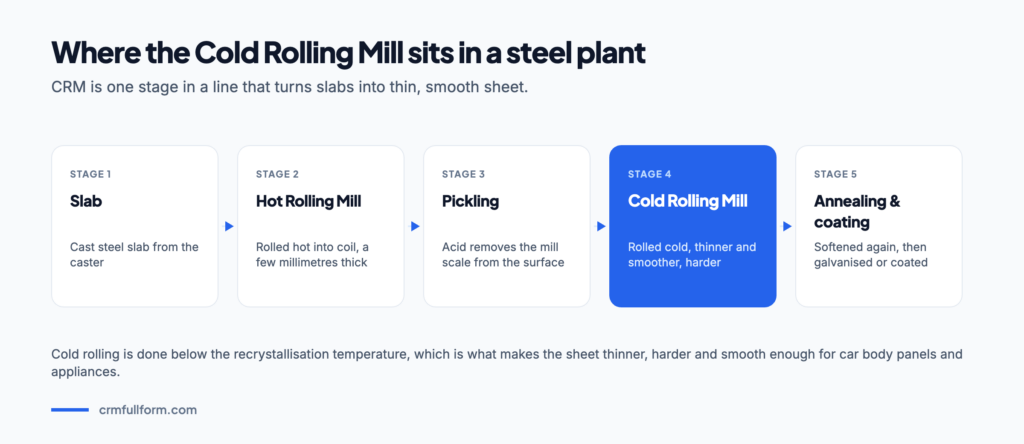
What is a Cold Rolling Mill?
A rolling mill squeezes steel between two heavy rolls, the way a sheet of dough is thinned with a rolling pin. A hot rolling mill does this while the steel is red hot. A cold rolling mill does it at room temperature.
Rolling cold takes far more force, because cold steel resists deformation. In return you get much better control. The thickness can be held to fine limits, the surface comes out bright and smooth, and the steel becomes harder and stronger as it is worked. In large integrated plants the whole area is called the CRM complex or CRM department, and it usually contains several lines rather than a single machine.
Hot rolling vs cold rolling
| Point | Hot Rolling Mill (HRM) | Cold Rolling Mill (CRM) |
|---|---|---|
| Temperature | Steel is rolled well above its recrystallisation temperature | Steel is rolled at room temperature |
| Surface | Darker, with mill scale | Bright, clean and smooth |
| Thickness control | Wider tolerance | Tight, closely held tolerance |
| Strength | Softer, easier to shape | Harder and stronger because of work hardening |
| Typical output | HR coils, plates, structural sections | CR coils and sheets, later galvanised or coated |
| Cost | Lower | Higher, because of extra processing |
The two are not competitors. Cold rolling starts where hot rolling stops: a hot rolled coil is the raw material fed into the cold rolling mill.
How a cold rolling mill works, step by step
- Pickling. The hot rolled coil is passed through acid to strip off the mill scale, then rinsed, dried and oiled. Rolling over scale would damage both the strip and the rolls.
- Cold rolling. The clean coil is rolled down to the target thickness, either in a tandem mill with several stands in a line or in a reversing mill that passes the strip back and forth. Coolant and lubricant are sprayed continuously.
- Cleaning. Rolling oil is washed off before heat treatment.
- Annealing. Cold rolling leaves the steel hard and brittle. Heating it in a batch annealing furnace or a continuous annealing line restores ductility so the sheet can be pressed and formed.
- Skin pass or temper rolling. A very light final rolling pass sets the surface finish, improves flatness and removes defects that would show up during pressing.
- Finishing. The strip is trimmed, inspected, recoiled or cut into sheets, weighed and packed.
- Coating, where required. Many CR coils go on to a galvanising line, a tinning line or a colour coating line for corrosion protection.
Why steel plants run a CRM
- Thin gauges. Car body panels and appliance sheets need thicknesses that hot rolling cannot hold accurately.
- Surface quality. A painted car panel needs a surface with no scale and no roughness.
- Strength with less weight. Work hardening lets a thinner sheet carry the same load.
- Higher value. A cold rolled and coated coil sells for considerably more than the hot rolled coil it was made from, so the CRM is where a plant adds margin.
Where cold rolled steel is used
| Industry | Typical product |
|---|---|
| Automobile | Body panels, doors, roofs, inner structures |
| Home appliances | Refrigerator and washing machine bodies, microwave cabinets |
| Construction | Roofing sheets, shutters, ducting, false ceiling frames |
| Packaging | Tinplate for food cans, drums and barrels |
| Furniture and hardware | Steel cabinets, racks, shelving |
Working in the CRM department
A cold rolling mill employs mechanical, electrical and metallurgical engineers along with operators and technicians. Mechanical teams look after rolls, bearings and hydraulics. Electrical teams handle drives, automation and the thickness control system. Metallurgists own the annealing cycles and the mechanical properties of the finished coil. Quality teams check thickness, flatness, surface and coating weight before despatch. Trainee engineer roles in CRM departments are a common entry point in large integrated steel plants.
CRM outside the steel plant
Walk into the same company’s sales office and CRM means something completely different. There the CRM full form is Customer Relationship Management — the software that tracks customers and orders. Steel plants and traders use that too, for dealer enquiries and order follow-up. See the best CRM software →
Frequently asked questions
What is the full form of CRM in a steel plant?
In a steel plant, CRM full form is Cold Rolling Mill. It is the unit that rolls hot rolled coil at room temperature to produce thinner, flatter and smoother steel sheet.
What is the difference between HRM and CRM in steel?
HRM is the Hot Rolling Mill, which rolls steel while it is very hot and produces coils and plates with a scaled surface. CRM is the Cold Rolling Mill, which rolls that coil at room temperature to get tight thickness control, a bright surface and higher strength.
What is the process in a cold rolling mill?
The usual sequence is pickling to remove scale, cold rolling to the target thickness, cleaning, annealing to restore ductility, a light skin pass for surface and flatness, then finishing and, where needed, galvanising or other coating.
Why is steel annealed after cold rolling?
Cold rolling work hardens the steel and leaves it hard and brittle. Annealing heats the strip so its structure recovers, which restores ductility and allows the sheet to be pressed and formed without cracking.
Where is cold rolled steel used?
Mainly in car body panels, home appliance bodies, roofing and shutters, tinplate for cans and drums, and steel furniture such as cabinets and shelving.
Related pages
- CRM full form — the main meaning and every industry in one table.
- CRM full form in electrical — Contact Resistance Measurement.
- CRM full form in medical — Cardiac Rhythm Management.
- CRM full form in court — the Criminal case-type code.