
The CRM process has five steps: reach, lead capture, conversion, retention and loyalty. A business repeats this cycle for every customer — get noticed, save the enquiry, close the sale, serve well enough that they stay, then turn them into a repeat buyer who refers others.
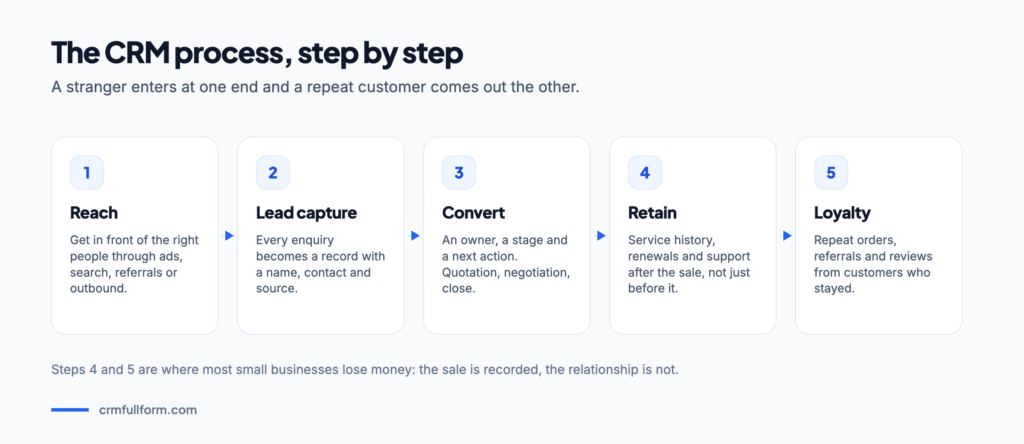
The 5 steps of the CRM process
| Step | Goal | Who owns it | Sign it is working |
|---|---|---|---|
| 1. Reach | Be seen by the right people | Marketing | Steady flow of new enquiries |
| 2. Lead capture | Save every enquiry with its source | Marketing and sales | No enquiry sitting unrecorded |
| 3. Conversion | Turn the lead into a paying customer | Sales | Conversion rate holding or rising |
| 4. Retention | Serve well so they stay | Support and service | Complaints closed on time, low churn |
| 5. Loyalty | Repeat purchases and referrals | Everyone | Repeat orders and word-of-mouth leads |
The process is the same whether you sell flats, training courses or software. Only the timeline changes. First, a quick reminder: the CRM full form is Customer Relationship Management, and the process below is what that phrase actually looks like in practice.
Step 1: Reach
Nothing happens until people know you exist. Reach is the work of getting in front of the right audience — search results, social posts, referrals, billboards, WhatsApp broadcasts, walk-in footfall or a dealer network.
The CRM contribution at this stage is targeting, not broadcasting. If your existing records show that most paying customers are aged 25 to 35 and live within five kilometres, you stop paying to reach everyone else. Analytical CRM is what turns old data into that decision.
Common mistake: spending on reach without tagging where each enquiry came from. Six months later nobody can say which channel paid for itself.
Step 2: Lead capture
A person who has shown interest but not bought yet is a lead. Capture means getting that person into the CRM with a name, a contact number, a source tag and an owner — automatically wherever possible.
- Website enquiry forms that write straight into the CRM.
- Missed-call and click-to-call numbers logged as leads.
- WhatsApp and social messages pulled in through an integration.
- Walk-in visitors entered by the front desk before they leave.
- Imported lists from exhibitions and events.
Example: a real estate office gets 40 enquiries a week across four channels. Before CRM, the ones that came in after hours were written on a pad and half were never called. After CRM, every enquiry is created instantly, assigned in rotation and shows up on someone’s task list the next morning.
Step 3: Conversion
Conversion is the work of moving a lead from interested to paying. In the CRM this is the pipeline — a row of stages that a deal passes through, such as New, Contacted, Quotation Sent, Negotiation, and finally Won or Lost.
Three things decide the conversion rate. Speed — the first business to call usually wins. Consistency — every lead gets the same number of follow-ups instead of depending on who is handling it. Record keeping — the objection raised on call one is on the screen during call three.
Lost deals matter as much as won ones. A CRM that forces a reason on every Lost deal — price too high, chose a competitor, project postponed — hands the owner a list of fixable problems within a quarter.
Step 4: Retention
Most businesses celebrate the sale and then go quiet. Retention is the step that decides whether the customer is still with you next year. It runs on service: complaints logged as tickets with owners and deadlines, renewal and warranty reminders raised before they expire, and check-in calls after delivery.
This is where collaborative CRM earns its keep. The support agent handling a complaint can see what sales promised, what was delivered and what the customer has already been told. Nobody has to ask the customer to explain their own history.
Example: an insurance agency sets a CRM reminder 45 days before every policy renewal. The customer gets a call while there is still time to compare, instead of a panicked message on the expiry date.
Step 5: Loyalty
The last step turns a satisfied customer into an active one. Loyalty shows up as repeat purchases, upgrades, and referrals that arrive without any advertising spend behind them.
- Segment by behaviour. Customers who bought twice deserve a different message from those who bought once.
- Ask at the right moment. A referral request lands best just after a complaint was resolved well.
- Track referral sources. Tag which customer sent which lead, so you know who your advocates are.
- Close the loop. A referral becomes a new lead, and the cycle starts again at capture.
Making the process stick
A CRM process fails for the same reasons every time: leads entered without a source, stages that nobody updates, and reports pulled once a quarter instead of once a week. Fixing it is unglamorous. Agree the stage names, make the source field compulsory, review the pipeline in a short weekly meeting, and insist that if it is not in the CRM it did not happen.
The three types of CRM map onto these steps neatly: operational CRM runs steps two to four, analytical CRM improves steps one and three, and collaborative CRM is what makes step four possible. If you are still choosing a tool, see the best CRM software →
Frequently asked questions
What are the 5 steps of the CRM process?
The five steps are reach, lead capture, conversion, retention and loyalty. A business gets noticed, records every enquiry, converts the lead into a sale, serves the customer well enough that they stay, and finally earns repeat purchases and referrals.
What is the CRM process in simple words?
It is the repeatable cycle a company follows for every customer: find them, save their details, sell to them, look after them and keep them coming back. A CRM system stores the record at each stage so nothing depends on memory.
What is lead capture in CRM?
Lead capture is the step where an interested person is saved into the CRM with a name, contact number, source tag and an owner. Website forms, missed calls, WhatsApp messages, walk-ins and event lists are the usual sources.
Why is retention part of the CRM process?
Because keeping an existing customer is usually cheaper than winning a new one. Retention covers complaint tickets with deadlines, renewal and warranty reminders, and follow-up after delivery — all recorded on the same customer record.
How is the CRM process different from the sales process?
The sales process stops at the closed deal. The CRM process continues past it into service, retention and loyalty, and then feeds referrals back into the start of the cycle.
Related pages
- CRM full form — the main meaning and every industry in one table.
- Types of CRM — operational, analytical and collaborative.
- Benefits of CRM — what a business gains from the process.
- Features of CRM — the tools that run each step.