
CRM Full Form: Customer Relationship Management
CRM full form is Customer Relationship Management. CRM is a system that keeps every customer detail — calls, emails, deals and support tickets — in one place, so a business can sell more and serve people better. In other fields, CRM has completely different full forms.
- 22industry meanings
- 18plain-English guides
- Freeno signup, ever
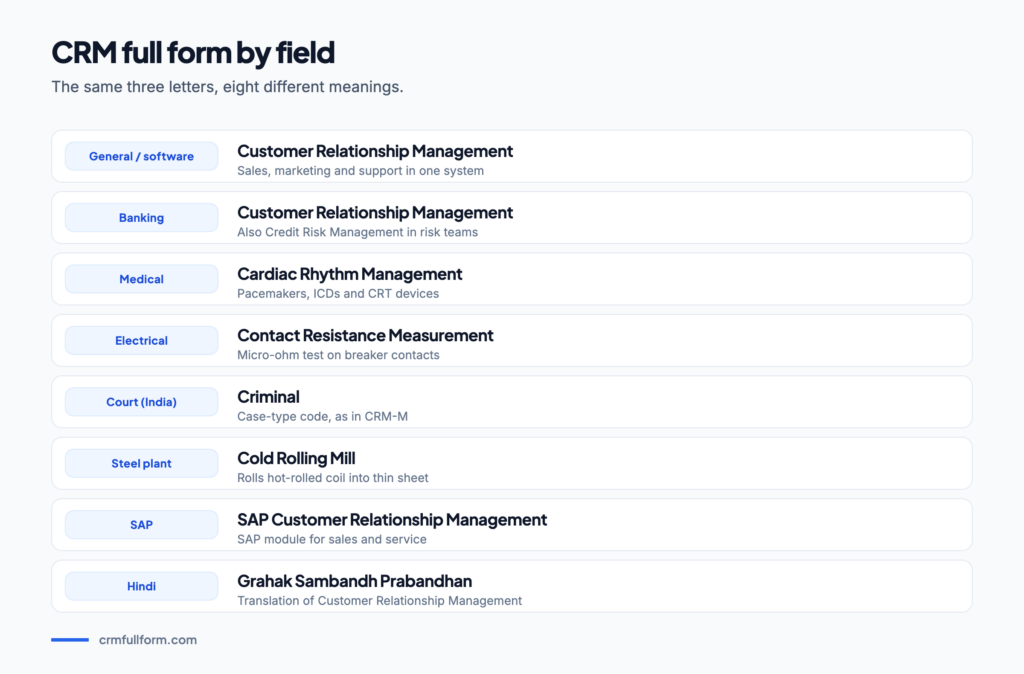
CRM Decoder — pick your field
Choose the field you are asking about. The full form changes with the field.
The main meaning. Software and a business method for managing customer data, sales and support in one place.
Also Credit Risk Management inside risk departments. CRM full form in banking →
Pacemakers and defibrillators that control heart rhythm. CRM full form in medical →
A test on circuit breakers and switchgear, measured in micro-ohms. CRM full form in electrical →
A case-type code in Indian case numbers, such as CRM-M. CRM full form in court →
The unit that rolls steel at room temperature into thin sheets. CRM full form in steel plant →
SAP’s CRM module for sales, service and marketing. SAP CRM full form →
No JavaScript needed. Every meaning is also listed in the table below.
CRM full form in every industry
Most people mean Customer Relationship Management. But if you saw CRM in a hospital, a court order, a steel plant or an electrical test report, it means something else entirely. Pick your field below.
Every other CRM full form, in one table
The cards above cover the fields people ask about most. CRM turns up in plenty more places, and it does not always mean customer software. Find where you saw the letters and read the page written for it.
| Where you saw CRM | What it stands for there |
|---|---|
| CRM software | Customer Relationship Management software |
| CRM system | Customer Relationship Management system |
| CRM tool | Customer Relationship Management tool |
| Marketing and digital marketing | Customer Relationship Management, also read as Customer Relationship Marketing |
| Computer science and IT | Customer Relationship Management |
| BPO and call centres | Customer Relationship Management |
| School, college and coaching | Customer Relationship Management |
| Real estate | Customer Relationship Management |
| Retail and e-commerce | Customer Relationship Management |
| Car showrooms and dealerships | Customer Relationship Management |
| Pharma and the medical representative | Customer Relationship Management |
| Finance, insurance and lending | Customer Relationship Management — or Credit Risk Mitigation |
| Hospitals and healthcare | Cardiac Rhythm Management — or Customer Relationship Management |
| Aviation and safety training | Crew Resource Management |
| Chemistry and laboratories | Certified Reference Material |
| A CRM test on switchgear | Contact Resistance Measurement |
| Construction and road work | Crusher Run Macadam — or Crumb Rubber Modifier |
| A CRM machine in a bank lobby | Cash Recycler Machine |
| A CRM post or designation | Customer Relationship Manager |
| A CRM visit or meeting | A visit logged in a Customer Relationship Management system |
| SFDC, MS CRM, Veeva, Odoo and other brands | Customer Relationship Management, whoever makes it |
| Mixed up with SRM, SCM, CMS, ORM or DMS | Different systems entirely — decoded here |
Why this reference is different
Answer first, always
Every page opens with the direct answer in the first 40 words — no scrolling past a filler introduction to find what CRM stands for.
Written in plain English
Short sentences, no jargon left unexplained. Built for students, job seekers and business owners, not for search engines.
Specialist topics handled carefully
Medical, legal and engineering pages explain terminology only, and say plainly where professional advice is required.
One term, every context
Banking, healthcare, engineering, law, manufacturing and enterprise software — the same three letters, mapped across all of them.
What is CRM?
CRM is a way of keeping every customer in one organised list instead of in scattered notebooks, chat threads and spreadsheets. A CRM tool stores the customer’s name, phone number, email, company, past purchases, open complaints and the next follow-up date. Anyone on the team can open the record and see the full history.
Think of a small training institute. A parent calls on Monday and speaks to one staff member. On Thursday the same parent calls again and a different staff member picks up. Without CRM, the second person starts from zero and the parent has to repeat everything. With CRM, the second person opens the record, sees the earlier call, the course discussed and the fee quoted, and continues the conversation. That is the whole idea.
CRM is two things at once, and this is where most people get confused:
- CRM as a strategy — the company decision to put the customer at the centre and to keep every interaction recorded.
- CRM as software — the actual tool, such as Zoho CRM or Salesforce, that stores the data and automates the follow-ups.
When someone asks for the CRM software full form, CRM tool full form or CRM system full form, the answer is the same three words: Customer Relationship Management. Only the word after CRM changes, not the abbreviation.
Other ways people ask for the CRM full form
The same question is typed in many ways. All of them have one answer.
| What people search | Answer |
|---|---|
| Full form of CRM | Customer Relationship Management |
| What is the full form of CRM | Customer Relationship Management |
| CRM stands for | Customer Relationship Management |
| CRM full form in Hindi | Grahak Sambandh Prabandhan — read the Hindi page |
| CRM software full form | Customer Relationship Management software |
| CRM tool full form | Customer Relationship Management tool |
| CRM system full form | Customer Relationship Management system |
How CRM works
A CRM works like a pipeline. A stranger enters at one end, and a paying customer comes out at the other end. Here are the steps in plain words.
- Capture. Someone fills a website form, calls the office or sends a WhatsApp message. The CRM saves them as a lead with a source tag.
- Assign. The lead is given to a sales person automatically, so nothing sits unanswered.
- Follow up. The CRM sets reminders. Calls, emails and notes are logged against the same record.
- Move the deal. The lead moves through stages — New, Contacted, Quotation Sent, Negotiation, Won or Lost.
- Serve and retain. After the sale, support tickets, renewals and feedback stay on the same record.
- Report. The manager sees how many leads came, how many closed, and who is performing.
Nothing here is complicated. The value comes from doing it consistently for every single customer. For a longer walkthrough with screenshots of each stage, read how CRM works step by step.
Types of CRM
CRM systems are grouped into three types. Most modern tools do all three, but the labels still appear in exams and interviews.
| Type | Main job | Example of use |
|---|---|---|
| Operational CRM | Runs the daily work — leads, deals, tickets, automation | Auto-assigning a new website enquiry to a sales rep |
| Analytical CRM | Studies the stored data and finds patterns | Finding which city gives the most repeat orders |
| Collaborative CRM | Shares customer information across teams | Support seeing what sales promised the customer |
Each type is explained with more examples on the types of CRM page.
The CRM process
The CRM process is the cycle a business repeats for every customer: reach the right people, capture the lead, convert the lead into a sale, retain the customer with good service, and build loyalty so they buy again and refer others. The five steps are broken down on the CRM process page.
Benefits of CRM
- No lead is forgotten. Every enquiry has an owner and a next step.
- Faster replies. The full history is on one screen, so nobody hunts through old chats.
- Better handovers. When a staff member leaves, the customer data stays with the company.
- Honest reporting. Managers see real numbers instead of verbal updates.
- Repeat business. Renewal and follow-up reminders bring old customers back.
- Less manual work. Automation handles reminders, emails and status updates.
The full list, with what each benefit looks like in a small business, is on the benefits of CRM page.
Common features of CRM software
Almost every CRM, cheap or expensive, includes the same core features: contact management, a visual sales pipeline, task and follow-up reminders, email and call logging, quotations and invoices, support ticketing, workflow automation, reports and dashboards, a mobile app, and permission settings that control who sees what. Each one is explained on the features of CRM page.
Examples of CRM software
These are the CRM tools you will hear about most often worldwide.
| CRM | Best known for | Usually chosen by |
|---|---|---|
| Zoho CRM | Low cost, wide feature set, Indian company | Small and mid-size businesses |
| Salesforce | The market leader, deeply customisable | Large companies and enterprises |
| HubSpot CRM | Free starting plan, marketing tools | Startups and marketing teams |
| Zoho Bigin | Very simple pipeline CRM | Very small teams and solo sellers |
| Pipedrive | Clean visual sales pipeline | Sales-first teams |
| Microsoft Dynamics 365 | Tight fit with Microsoft 365 | Companies already on Microsoft |
More tools, with what each one is actually used for, are listed on the CRM examples page. Looking for a CRM for your business? See the best CRM software →
CRM vs ERP — how they are different
CRM and ERP are often confused because both are business software with three-letter names. CRM means Customer Relationship Management and looks outward at customers. ERP means Enterprise Resource Planning and looks inward at the company’s own resources — stock, accounts, purchase, production and payroll.
| Point | CRM | ERP |
|---|---|---|
| Full form | Customer Relationship Management | Enterprise Resource Planning |
| Focus | Customers, sales, service | Inventory, finance, operations |
| Main users | Sales, marketing, support teams | Accounts, stores, production, HR |
| Main goal | Earn more revenue | Cut cost and waste |
The full comparison is on the CRM vs ERP page.
Who uses CRM?
CRM is not only for big corporate offices. In practice these are the people who open a CRM every working day:
- Sales teams — to track leads and close deals on time.
- Support teams — to handle complaints without losing the history.
- Marketing teams — to see which campaign actually produced paying customers.
- Banks and lenders — relationship managers use CRM for loans, deposits and service requests.
- Schools, training centers and hospitals — to manage admissions, appointments and follow-ups.
- Shops and small businesses — even a two-person team benefits from one shared customer list.
CRM as a career
CRM is also a job title. A CRM executive keeps the customer database clean, follows up on leads, sends campaigns and pulls reports for the manager. It is a common entry-level role in banks, real estate, education and IT companies, and it does not need a technical degree to start.
If you are studying for a job, start with what a CRM executive does, then follow the free roadmap in how to learn CRM, and finally practise with the top CRM interview questions.
Why the CRM full form matters
Knowing the words behind the abbreviation changes how you use the tool. “Customer” means the record must be about a real person, not a random row of data. “Relationship” means the goal is the next conversation, not just today’s sale. “Management” means somebody is responsible for keeping the record updated. Teams that remember these three words keep their CRM clean. Teams that treat CRM as just software end up with a database nobody trusts.
The same logic applies in other fields. In a hospital, Cardiac Rhythm Management is literally about managing the rhythm of the heart. In a steel plant, a Cold Rolling Mill really does roll steel cold. The abbreviation is short, but the full form always tells you what the thing does. Read more about why CRM is important for every business.
CRM words you will hear on day one
Every CRM uses roughly the same vocabulary. Learn these eight words and most CRM screens stop looking confusing.
| Word | Simple meaning |
|---|---|
| Lead | A person who showed interest but has not bought yet. |
| Contact | A real person with a name, phone number and email saved. |
| Account | The company that the contact works for. |
| Deal or Opportunity | A possible sale, with an amount and an expected closing date. |
| Pipeline | The set of stages a deal passes through, from new to won. |
| Activity | A call, meeting, email or task logged against a record. |
| Ticket | A complaint or service request raised after the sale. |
| Workflow | An automatic rule, such as sending a reminder after three days of silence. |
Cloud CRM and on-premise CRM
A cloud CRM runs on the vendor’s servers. You pay a monthly fee per user, open it in a browser or mobile app, and the vendor handles updates, backups and security patches. Almost every small and mid-size business today uses a cloud CRM because there is nothing to install and the cost starts low.
An on-premise CRM is installed on the company’s own servers. It costs more upfront and needs an IT team, but the data stays inside the company’s own network. Banks, defence suppliers and some large manufacturers still prefer this for data-control reasons. The CRM full form does not change either way — only the place where the software runs changes.
How to choose a CRM: five practical checks
- Count your users first. CRM pricing is per user per month. Ten users on a mid tier plan can cost more than the software you are replacing, so do the multiplication before the demo call.
- Check the mobile app. If your sales team works on the road, they will update records on a phone or not at all. Open the app on a real phone during the trial.
- Test the imports. Take your existing customer spreadsheet and import it during the free trial. If the import is painful, adoption will be painful.
- Ask about integrations. The CRM should connect to the tools you already use — email, WhatsApp, your website forms, your accounting software and your calling system.
- Confirm you can export. Make sure you can download your own data as a file at any time. This keeps you free to move later.
Common CRM mistakes to avoid
- Buying too many features. A team of four rarely needs an enterprise plan. Start small and upgrade when the limits actually hurt.
- Letting data go stale. A CRM with half-filled records is worse than a clean spreadsheet, because people stop trusting it.
- Skipping training. One hour of training on the first day saves months of wrong entries.
- Using it only as a report tool. If the team fills the CRM only so the manager can take a report, the entries will be rushed and inaccurate.
- Running two systems together. Once the CRM is live, close the old spreadsheet. Two sources of truth means neither is true.
Frequently asked questions about the CRM full form
What is the full form of CRM?
The full form of CRM is Customer Relationship Management. It is both a business strategy and a type of software used to store customer details, manage sales and handle support in one place.
What does CRM stand for in business?
In business, CRM stands for Customer Relationship Management. It refers to the system a company uses to track leads, deals, customers and service requests so that no enquiry or follow-up is missed.
Is the CRM full form different in other industries?
Yes. In the medical field CRM means Cardiac Rhythm Management, in electrical work it means Contact Resistance Measurement, in Indian courts it means Criminal, and in a steel plant it means Cold Rolling Mill. In banking it usually means Customer Relationship Management and sometimes Credit Risk Management.
What is the CRM full form in Hindi?
In Hindi, CRM translates to Grahak Sambandh Prabandhan, which means Customer Relationship Management. Our CRM full form in Hindi page explains the term with examples.
What is the CRM software full form?
CRM software full form is Customer Relationship Management software. The abbreviation does not change when you add the words software, tool or system after it.
Which CRM software is best for a small business?
For most small businesses worldwide, Zoho CRM, Zoho Bigin and the free HubSpot CRM plan are the usual starting points because they are low cost and simple to set up. Compare the options on our best CRM software page.
CRM full form in one minute — quick summary
- CRM full form is Customer Relationship Management in business and software, and this is the meaning behind almost every search for the term.
- A CRM keeps customer details, sales deals and support tickets in one shared record instead of in separate diaries and spreadsheets.
- The three types are operational, analytical and collaborative, and most modern tools cover all three.
- CRM is not ERP. CRM manages customers and revenue; ERP manages stock, accounts and internal operations.
- The meaning changes with the field. Medical means Cardiac Rhythm Management, electrical means Contact Resistance Measurement, court means Criminal, and a steel plant means Cold Rolling Mill.
- CRM is also a job. CRM executive and relationship manager roles are open to fresh graduates in banks, real estate, education and IT.
Looking for CRM software, not the definition?
We compared ten CRM tools on price band, free plans, strengths and weak points — so you can shortlist in five minutes instead of five demos.
See the best CRM softwareRelated pages
- CRM full form in banking — both meanings used inside banks.
- CRM full form in medical — Cardiac Rhythm Management explained.
- Types of CRM — operational, analytical and collaborative.
- Best CRM software — top tools compared.