
There are three main types of CRM: operational, analytical and collaborative. Operational CRM runs the daily sales and service work. Analytical CRM studies the data and finds patterns. Collaborative CRM shares that customer information across teams. Many people add a fourth, strategic CRM.
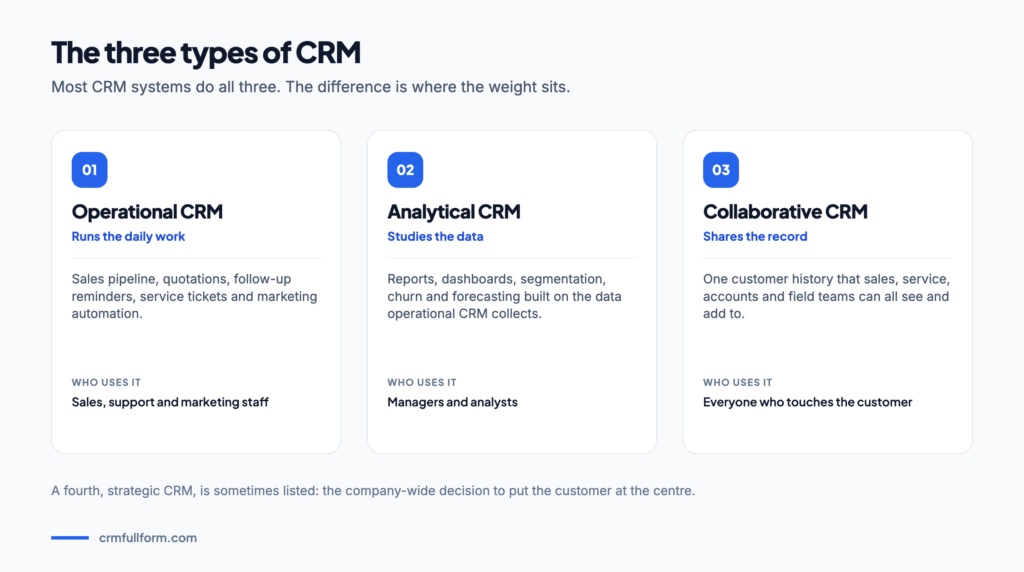
Types of CRM at a glance
| Type | Main job | Who uses it most | Typical output |
|---|---|---|---|
| Operational CRM | Run and automate the daily work | Sales, support and marketing staff | Leads assigned, deals moved, tickets closed |
| Analytical CRM | Study stored data and find patterns | Managers and analysts | Reports, segments, forecasts |
| Collaborative CRM | Share customer information across teams | Everyone who touches the customer | One shared history, fewer repeated questions |
| Strategic CRM | Set the customer-first policy behind all of it | Owners and senior management | Decisions about which customers to focus on |
Before the types make sense, it helps to know the words behind the abbreviation. The CRM full form is Customer Relationship Management.
what is CRM software for the full definition of the software.
1. Operational CRM
Operational CRM is the type most people picture when they hear the word CRM. It is the system your team actually opens every morning. Its job is to run the routine work of finding, winning and serving customers, and to automate the parts that would otherwise be forgotten.
It usually covers three areas. Sales automation handles leads, deals, quotations and follow-up reminders. Marketing automation handles campaign lists, emails and lead capture from the website. Service automation handles complaint tickets, assignment rules and resolution deadlines.
Example: a customer fills the enquiry form on a builder’s website at 11 p.m. The operational CRM creates a lead, tags the source as Website, assigns it to the sales executive on duty, sends the customer an acknowledgement email, and puts a call reminder on the executive’s list for 10 a.m. No human touched any of that.
Choose it when leads are slipping, follow-ups depend on memory, or nobody can say who is handling which customer.
2. Analytical CRM
Analytical CRM does not run the daily work. It reads the data that the operational side has been collecting and turns it into decisions. Where operational CRM asks “what do I do next?”, analytical CRM asks “what has been happening, and what should we change?”
Typical outputs are customer segments, sales forecasts, conversion analysis by source, profitability by product or region, and lists of customers who look likely to leave.
Example: a training institute compares six months of enrolment data and finds that leads from Instagram convert at a far lower rate than walk-ins, but that walk-ins mostly arrive after seeing Instagram. That single insight changes how the marketing budget is split.
Choose it when you already have a year or two of clean data and decisions are still being made on gut feel.
3. Collaborative CRM
Collaborative CRM — sometimes called strategic or shared CRM — is about making sure that everyone who deals with a customer sees the same record. It matters most in companies where sales, support, delivery and accounts sit in different teams or different cities.
Two ideas sit inside it. Interaction management keeps every conversation in one place, whatever channel it came through — phone, email, WhatsApp, website chat or a walk-in visit. Channel management decides which channel each customer prefers and routes future contact accordingly.
Example: a customer complains on WhatsApp about a delayed delivery. The support agent opens the record, immediately sees that the sales team promised a date the warehouse could not meet, apologises with the correct facts, and flags the mismatch back to sales. Without a shared record the agent would have guessed.
Choose it when customers complain about repeating themselves, or when two departments give the same customer different answers.
4. Strategic CRM
Some textbooks list a fourth type. Strategic CRM is not software at all — it is the company-level decision to build the business around keeping customers rather than chasing one-off sales. It shows up in choices such as which customer groups to serve, how much to spend on retention against acquisition, and whether staff bonuses reward repeat business or only new orders.
You will meet this fourth type mainly in exams and MBA courses. In a software comparison, only the first three matter.
Which type of CRM do you need?
| Your problem | Type that fixes it |
|---|---|
| Leads are not followed up on time | Operational |
| Nobody knows which marketing spend works | Analytical |
| Support does not know what sales promised | Collaborative |
| The team chases new customers and ignores old ones | Strategic |
In practice you rarely buy one type. Almost every modern cloud CRM does all three: it runs the daily work, produces dashboards, and shares one record across teams. The labels survive because they describe three different reasons for buying, and because exams still ask for them.
What actually differs between products is depth. Simple tools are strong on the operational side and thin on analytics. Enterprise platforms go deep on analytics but need a specialist to set up. Comparing real options? See the best CRM software →
How the three types work together
Think of one customer journey. Operational CRM captures the enquiry and pushes the follow-up. Collaborative CRM makes sure support later sees what was promised during that follow-up. Analytical CRM then looks across a thousand such journeys and tells the owner which source, product and city are worth more attention. Remove any one of the three and the other two get weaker. The full sequence is set out on the CRM process page.
Other ways CRM systems are classified
Operational, analytical and collaborative describe what a CRM does. Two other groupings come up often in buying decisions.
| Grouped by | Options | What it changes |
|---|---|---|
| Where it runs | Cloud CRM, on-premise CRM, open-source CRM | Cost model, who maintains it, and where the data sits |
| Who you sell to | B2B CRM, B2C CRM | B2B tools centre on companies and long deal cycles; B2C tools centre on individuals and high volume |
| Industry fit | General CRM, industry CRM | Industry versions ship with ready fields and workflows for real estate, education, banking or healthcare |
A small business almost always ends up with a cloud, general-purpose CRM that is strong on the operational side. Larger companies mix and match — an industry-specific platform for sales, a separate analytics layer on top, and integrations that keep both in step.
Frequently asked questions
What are the 3 types of CRM?
The three types of CRM are operational, analytical and collaborative. Operational CRM runs the daily sales, marketing and service work. Analytical CRM studies the stored data to find patterns. Collaborative CRM shares customer information across teams.
What is operational CRM?
Operational CRM is the type that runs and automates daily work — capturing leads, assigning them, moving deals through stages, sending reminders and handling support tickets. It is the screen a sales or support person opens every day.
What is analytical CRM used for?
Analytical CRM reads the data collected by the operational system and turns it into decisions. It produces customer segments, sales forecasts, conversion analysis by lead source, profitability reports and lists of customers at risk of leaving.
What is collaborative CRM?
Collaborative CRM makes sure every team that deals with a customer sees the same record. It keeps interactions from all channels in one history and routes future contact through the channel the customer prefers, so nobody has to repeat themselves.
Is strategic CRM a fourth type?
Many textbooks list strategic CRM as a fourth type. It is not software but a company-level decision to build the business around keeping customers, which then shapes budgets, targets and staff incentives.
Do I need to buy all three types separately?
No. Almost every modern cloud CRM covers all three in one product. The labels describe three different reasons for buying rather than three separate purchases, and what really differs between products is how deep each side goes.
Related pages
- CRM full form — the main meaning and every industry in one table.
- CRM process — the five steps from reach to loyalty.
- Features of CRM — the ten features every CRM has.
- CRM vs ERP — how CRM differs from ERP.