
Customer relations refers to the way a business builds, manages, and maintains relationships with its customers throughout the entire customer journey. It includes interactions before, during, and after a purchase, from answering initial questions and converting prospects to providing customer support, collecting feedback, and encouraging long-term loyalty.
Strong customer relations go beyond simply responding to complaints or answering support tickets. They involve creating an experience in which customers feel understood, valued, respected, and supported.
A business can have an excellent product, competitive pricing, and effective marketing, but poor customer relations can still lead to customer churn. On the other hand, companies that consistently communicate well, solve problems quickly, listen to feedback, and deliver on their promises can build relationships that encourage repeat purchases and referrals.
Customer relationship management is closely connected to this process. Businesses that want to understand the broader concept can explore our detailed guide to what CRM is, which explains how CRM systems organize customer information, sales activities, and support interactions.
What Is Customer Relations?
Customer relations is the overall approach a business uses to create and maintain positive relationships with existing and potential customers.
It covers every meaningful interaction between a customer and a company. These interactions can happen through a website, email, telephone, social media, live chat, messaging applications, sales meetings, customer support portals, or physical locations.
Customer relations may include:
- Answering customer questions
- Providing product or service information
- Helping customers make purchasing decisions
- Resolving complaints and problems
- Providing after-sales support
- Collecting customer feedback
- Personalizing communication
- Following up after important interactions
- Managing customer expectations
- Improving the customer experience
- Building long-term customer loyalty
The objective is not simply to complete a transaction. The objective is to develop a relationship that gives customers a reason to continue choosing the business.
Modern CRM systems support this process by bringing customer data and interactions together. Salesforce, for example, describes CRM as a system for managing interactions with current and potential customers, including sales, marketing, and customer service interactions.
Customer Relations vs. Customer Service
Customer relations and customer service are closely related, but they are not identical.
Customer service generally focuses on helping customers with specific questions, problems, or requests. A customer might contact a company because an order is late, a payment has failed, or they need help using a product.
Customer relations has a broader perspective. It considers the entire relationship between the customer and the business, rather than one individual support interaction.
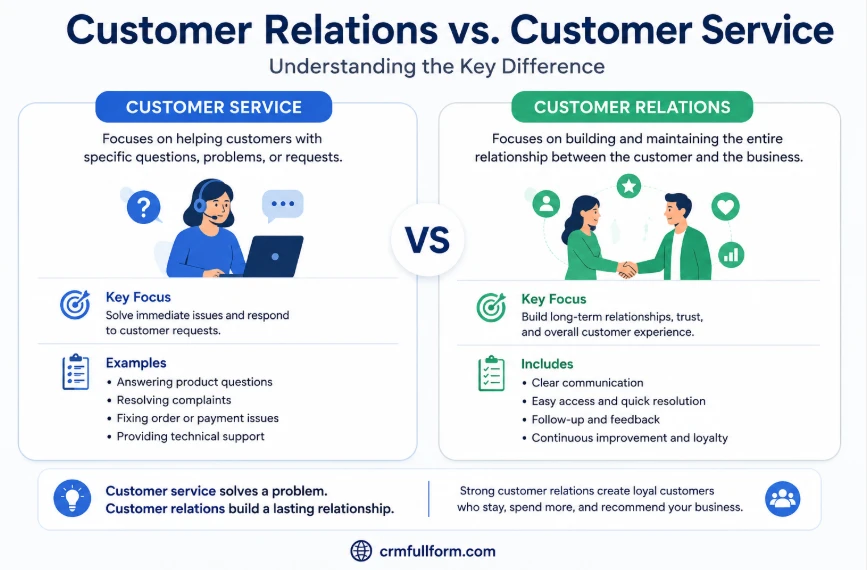
For example, customer service may resolve a customer’s billing problem. Customer relations considers the complete experience: how clearly the billing information was communicated, how easy it was to contact the company, how quickly the problem was resolved, whether the customer received a follow-up, and whether the company learned from the issue.
This distinction is important because a company can provide basic customer service without necessarily creating strong customer relationships.
Businesses that want to understand the systems supporting these activities can also explore CRM software and its role in customer management.
Why Is Customer Relations Important?
Customer relations can directly influence customer satisfaction, retention, loyalty, reputation, and revenue.
Builds Customer Trust
Trust is one of the foundations of a strong customer relationship.
Customers expect businesses to provide accurate information, deliver what they promise, protect customer information, and communicate honestly when something goes wrong.
A business that consistently meets expectations gradually builds credibility. When customers trust a company, they are more likely to purchase again and recommend it to others.
Increases Customer Loyalty
Positive customer experiences can turn occasional buyers into loyal customers.
Loyalty develops when customers repeatedly receive value and have confidence that the company will continue to meet their expectations.
A loyal customer may:
- Purchase repeatedly
- Renew subscriptions
- Upgrade products or services
- Recommend the business
- Leave positive reviews
- Defend the brand when others criticize it
Customer relations therefore contributes to value far beyond the initial transaction.
Improves Customer Retention
Businesses invest considerable time and resources into acquiring customers. Retention allows them to protect that investment by encouraging existing customers to remain active.
Poor communication, unresolved complaints, confusing processes, and inconsistent service can increase customer churn.
Strong customer relations helps companies identify dissatisfaction earlier and address problems before customers decide to leave.
Strengthens Brand Reputation
Customer experiences influence how people perceive a business.
A customer who receives exceptional support may recommend the company to friends, colleagues, or online communities. A customer who experiences repeated problems may share that experience publicly.
As a result, customer relations can affect brand reputation both online and offline.
Generates Valuable Feedback
Customers interact directly with products and services, which means they can provide insights that internal teams may overlook.
Feedback can reveal opportunities to improve:
- Products
- Services
- Pricing
- Website usability
- Customer support
- Onboarding
- Delivery
- Communication
- Documentation
The most effective companies do not simply collect feedback. They analyze recurring patterns and act on them.
Key Elements of Effective Customer Relations
Several elements form the foundation of successful customer relations.
Clear Communication
Customers should be able to understand what a business is saying without unnecessary complexity.
Effective communication should be clear, accurate, timely, and relevant.
This applies to product descriptions, pricing information, sales conversations, support responses, invoices, policies, and follow-up messages.
Active Listening
Listening to customers means more than allowing them to explain a problem.
Businesses should pay attention to recurring complaints, suggestions, questions, and expectations. When the same issue appears repeatedly, it may indicate a weakness in the product or process.
Customer conversations can therefore become an important source of business intelligence.
Personalization
Customers increasingly expect companies to understand their individual circumstances.
Personalization might involve recommending a relevant product, remembering previous interactions, tailoring onboarding, or sending communication based on a customer’s needs.
However, personalization should provide genuine value. Excessive or inappropriate use of personal information can have the opposite effect and reduce customer trust.
Effective Problem Resolution
Problems are inevitable in almost every business.
What matters is how the company responds when something goes wrong.
A strong process should:
- Acknowledge the issue.
- Understand the customer’s situation.
- Explain what will happen next.
- Provide a realistic timeline.
- Resolve the problem.
- Follow up when appropriate.
- Record the outcome for future reference.
The goal should not simply be to close a support ticket. The goal is to restore customer confidence.
Consistency Across Channels
Customers can interact with a company through multiple channels.
A customer might discover a company through Google, visit its website, contact sales through email, purchase through an online store, and later request support through live chat.
The experience should remain consistent across these touchpoints.
Customers should not have to repeatedly explain their history simply because they moved from one communication channel to another.
Customer Relations Strategies for Businesses
Businesses can improve customer relationships by implementing structured processes instead of relying entirely on individual employees.
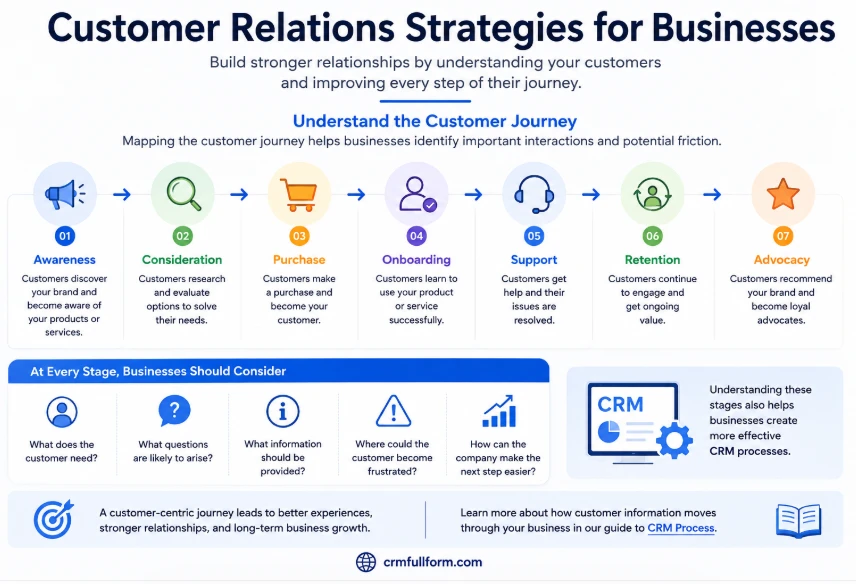
Understand the Customer Journey
Mapping the customer journey helps businesses identify important interactions and potential friction.
A typical customer journey might look like:
Awareness → Consideration → Purchase → Onboarding → Support → Retention → Advocacy
At every stage, businesses should consider:
- What does the customer need?
- What questions are likely to arise?
- What information should be provided?
- Where could the customer become frustrated?
- How can the company make the next step easier?
Understanding these stages also helps businesses create more effective CRM processes.
For a deeper explanation of how customer information moves through a business, see our guide to the CRM process.
Collect Customer Feedback
Customer feedback can come from:
- Surveys
- Reviews
- Support tickets
- Sales conversations
- Customer interviews
- Social media
- Online communities
- Product usage data
However, collecting feedback without acting on it can frustrate customers.
Businesses should categorize feedback, identify recurring issues, prioritize improvements, and communicate important changes when appropriate.
Follow Up After Important Interactions
A simple follow-up can significantly improve the customer experience.
For example, after resolving a serious support issue, a company can ask whether the solution worked. After onboarding a new customer, the business can check whether additional assistance is needed.
These interactions show that the company cares about the outcome rather than simply completing a task.
Empower Customer-Facing Employees
Employees who deal directly with customers need adequate training, information, and authority.
If employees must escalate every minor issue, customers may experience unnecessary delays.
Giving customer-facing employees appropriate decision-making authority can make problem resolution faster while improving the overall customer experience.
Use Customer Relationship Management Technology
As a business grows, manually tracking customer information becomes increasingly difficult.
A CRM system can centralize customer records, interactions, sales opportunities, follow-ups, and support information.
CRM platforms can help businesses create a single source of customer information rather than keeping important details across separate spreadsheets, email accounts, notes, and applications.
HubSpot similarly describes CRM as a centralized database for business relationships and processes, with records that can contain customer information and interaction history.
Businesses that want to understand the terminology in more detail can also review our CRM dictionary and CRM terminology resources.
The Role of CRM in Customer Relations
Customer relations becomes increasingly difficult to manage as a company grows.
A small company might remember customers through personal interactions. A larger company may have thousands of customers interacting with sales, marketing, support, finance, and account-management teams.
A customer relationship management system helps centralize this information.
For example, a sales representative can review previous conversations before contacting a prospect. A support agent can view account history before responding to a complaint. A marketing team can use customer information to create more relevant campaigns.
This creates a more connected customer experience.
The relationship between CRM and customer relations becomes especially important when different departments need access to the same customer information.
Businesses can also learn more about the different types of CRM and how operational, analytical, and collaborative CRM approaches support different business requirements.
Customer Relations Best Practices
Put the Customer Experience First
Businesses should regularly evaluate their processes from the customer’s perspective.
Ask:
- Is this process easy to understand?
- Can customers find the information they need?
- How long does it take to receive a response?
- Are customers required to repeat information?
- Is the company making unnecessary steps difficult?
Removing friction can improve customer satisfaction.
Be Honest When Problems Occur
Mistakes happen.
Trying to hide problems can create greater damage than the original mistake.
When an issue occurs, businesses should acknowledge it, explain the situation, provide realistic expectations, and communicate progress.
Transparency can protect trust even when the original experience was negative.
Respond Quickly
Response time matters, especially when customers are experiencing problems.
A company may not always be able to provide an immediate solution, but acknowledging the request and providing a realistic timeline can reassure the customer.
Keep Promises
Businesses should avoid making promises they cannot consistently fulfill.
Reliable delivery, accurate product information, transparent pricing, and dependable follow-up are essential components of customer trust.
Turn Complaints Into Improvement Opportunities
Complaints can reveal weaknesses.
Instead of treating each complaint as an isolated event, businesses should identify whether similar complaints are occurring repeatedly.
For example, hundreds of customers asking the same question may indicate that a product page, onboarding process, or help article needs improvement.
How to Measure Customer Relations
Customer relations should be measured through a combination of quantitative metrics and qualitative feedback.
Important customer relationship metrics include:
- Customer Satisfaction Score (CSAT)
- Net Promoter Score (NPS)
- Customer retention rate
- Customer churn rate
- Customer lifetime value (CLV)
- First response time
- Average resolution time
- Repeat purchase rate
- Customer complaint rate
- Support ticket volume
These metrics can help businesses determine whether customer relationships are improving.
However, numbers alone cannot explain every customer experience. Businesses should combine performance metrics with customer comments, interviews, reviews, and support conversations.
Examples of Good Customer Relations
Customer relations can be demonstrated in many different industries.
An e-commerce company might proactively notify customers about a delivery delay instead of waiting for customers to complain.
A software company might provide personalized onboarding based on the customer’s objectives.
A professional services company might follow up after completing a project to ensure the customer is satisfied.
A subscription business might identify customers who are struggling with the product and provide additional training before they decide to cancel.
A retail business might use purchase history to provide relevant recommendations without overwhelming customers with unnecessary promotions.
In each example, the company is doing more than responding to a request. It is actively trying to create a better long-term relationship.
Common Customer Relations Mistakes
Some businesses damage customer relationships through avoidable practices.
Common mistakes include:
- Ignoring customer feedback
- Responding too slowly
- Transferring customers repeatedly between departments
- Providing inconsistent information
- Making unrealistic promises
- Using confusing language
- Focusing only on sales
- Treating complaints as a nuisance
- Failing to follow up
- Creating unnecessary customer effort
- Keeping customer information in disconnected systems
Many of these problems can be reduced by combining strong customer-focused processes with appropriate CRM technology.
Customer Relations in the Digital Age
Digital technology has created more ways for businesses to interact with customers.
Customers can communicate through websites, social media, email, live chat, messaging platforms, mobile applications, and review websites.
This creates more opportunities for engagement, but it also increases customer expectations.
Customers often expect fast responses, convenient communication, personalized experiences, transparency, and easy access to information.
CRM technology can help businesses organize these interactions. Modern CRM platforms can connect sales, marketing, service, and customer data so teams can work from a more complete view of the customer.
Artificial intelligence and automation can further support customer relations by helping businesses categorize requests, automate repetitive tasks, identify patterns, and provide self-service assistance.
However, automation should complement human interaction rather than replace empathy and judgment when customers face complicated or sensitive situations.
Customer Relations and Customer Relationship Management
The relationship between customer relations and CRM is worth understanding.
Customer relations is primarily about the relationship and experience a customer has with a business.
CRM is the strategy, process, and technology used to organize customer information and manage interactions at scale.
For example, customer relations might involve ensuring that a customer receives a helpful and personalized experience. CRM software can provide the employee with the customer’s previous conversations, purchases, preferences, open issues, and follow-up history needed to deliver that experience.
This is why customer relations and CRM often work together.
Companies looking to understand the broader technology can explore our guide to CRM software and learn how different CRM features support sales, marketing, service, and customer management.
Frequently Asked Questions About Customer Relations
What does customer relations mean?
Customer relations refers to the way a business develops, manages, and maintains relationships with customers. It includes communication, customer support, feedback, problem resolution, personalization, retention, and other interactions throughout the customer journey.
What is the difference between customer relations and customer service?
Customer service usually focuses on helping customers with specific questions or problems, while customer relations covers the broader relationship between a customer and a business before, during, and after a purchase.
Why is customer relations important?
Customer relations is important because it can improve customer satisfaction, trust, loyalty, retention, reputation, repeat purchases, and referrals.
How can a business improve customer relations?
A business can improve customer relations by communicating clearly, responding quickly, listening to feedback, resolving problems effectively, personalizing experiences, empowering employees, and maintaining consistent experiences across communication channels.
How does CRM help with customer relations?
CRM helps businesses organize customer information and interaction history in one place. This allows sales, marketing, and support teams to understand customers better and provide more coordinated experiences.
What are examples of customer relations?
Examples include proactively communicating delivery delays, following up after resolving a support problem, providing personalized onboarding, responding to customer feedback, and helping customers before they experience a problem.
What metrics measure customer relations?
Common metrics include CSAT, NPS, customer retention rate, churn rate, customer lifetime value, response time, resolution time, repeat purchase rate, and complaint rate.
Conclusion
Customer relations is the ongoing process of building trust, satisfaction, loyalty, and value through interactions between a business and its customers.
It goes beyond traditional customer service because it considers the complete customer relationship rather than a single support request.
Businesses that communicate clearly, listen to customers, resolve problems effectively, personalize experiences, collect meaningful feedback, and consistently deliver on their promises can create stronger and more profitable customer relationships.
CRM technology can make these relationships easier to manage as a company grows. By centralizing customer information and interaction history, CRM systems help teams coordinate their work and create more consistent customer experiences.
Ultimately, strong customer relations comes down to a straightforward principle: understand customers, respect their time, solve their problems, and consistently provide value.
For readers who want to continue learning about CRM, explore the CRM Full Form and complete CRM guide for related definitions, processes, types, software terminology, and practical CRM resources.