
CRM Stock at a Glance
Looking for CRM stock? What you‘re probably actually searching for is Salesforce Inc. (NYSE: CRM) and not the meaning of “customer relationship management”. The company in question is a leader among enterprise software organizations and a fascinating speculative proposition for investors, largely because the company seems intent upon leveraging potential AI competition in the SaaS industry into growth. Trades at its CRM stock in the most recent public information available was trading in the mid$260.00 range, and it possesses a market capitalization of approximately$217 billion with a trailing P/E of around 23.5.
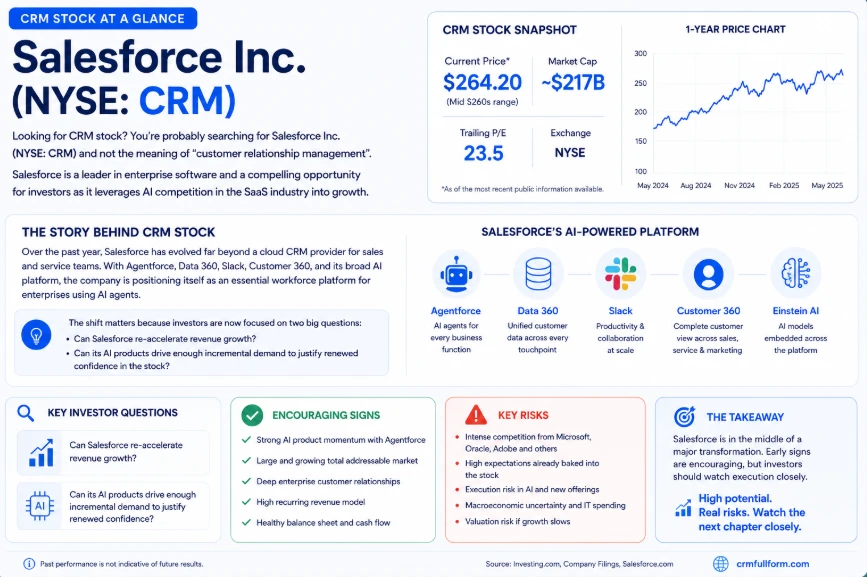
The story behind CRM stock has changed dramatically over the past year. Salesforce no longer absolutely positions itself as a cloud CRM provider that supports software application subscriptions for revenue and mobile teams. Umvegis Agentforce, Data 360, Slack, Customer 360, og sín breiða AI-pall, ger stovnurin eina roynd at koma at vera eitt lívsneyðugt arbeiðslag hjá stovnum, sum brúka AI-seljarar. Tað skiftið evni orsakað av, at handilsfólk hyggja nærri eftir tveimum spurningum: kann Salesforce endurskunda inntøkuvøksturin, og kann tess AI vøra skapa nóg mikið av stigvísum kalli til at rættvísgera endurnýggjað álit innan goymsluna? Its consequences today offer a few encouraging signs, although the risks remain.
What Is CRM Stock?
CRM inventory is the stock symbol of Salesforce, Inc., which trades on the New York Stock Exchange under the symbol CRM. Founded via Marc Benioff, the employer has grown from a cloud-based sales software publisher into a giant employer generation platform that protects revenue, customer support, marketing, commerce, analytics, data, collaboration, and synthetic intelligence. This distinction is vital for all and different research keyword due to the fact that “CRM” is likewise commonly used as an abbreviation for user-friendly management. In financial terms, however, CRM inventory is generally method Salesforce inventory.
Salesforce’s investment story is closely connected to the transition from traditional cloud software toward AI-powered enterprise applications. Historically, customers paid Salesforce for applications that helped employees manage leads, accounts, opportunities, customer support cases, marketing campaigns, and other business workflows. Today, Salesforce is adding AI agents that can perform tasks rather than simply display information or generate suggestions. The company describes its current strategy around humans and AI agents working together through an integrated platform, with Agentforce serving as a major part of that vision.
Salesforce Stock Price Today
The payment of CRM shares varies throughout the buying and selling period, so investors should treat any payment as a symbolic payment, not a permanent decision. Today’s market facts available for this article showed Salesforce at about $264.Three quarters corresponds to the dividend after a conference call in which inventories gained about 2.9%. The day trading market was $258.62 to $268.14, showing how fast dividend fees can run even in the unmarried.
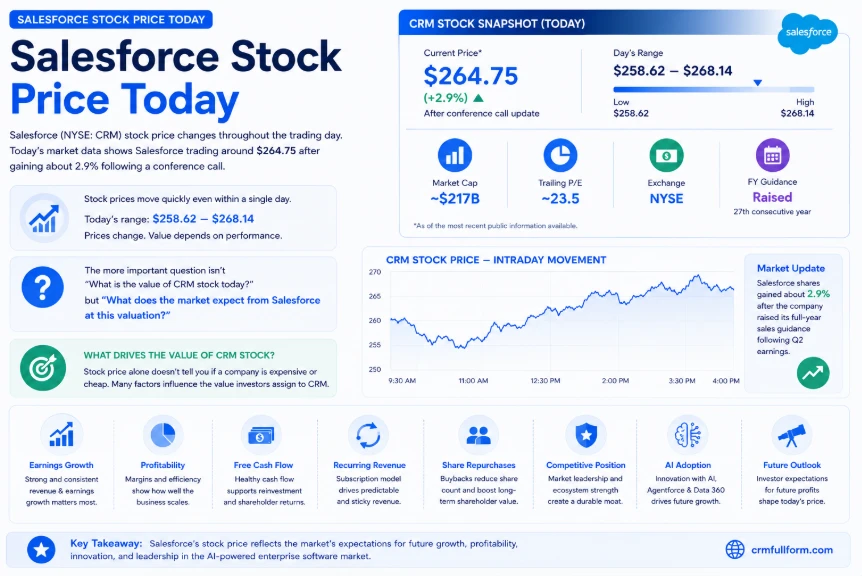
For businesses learning Salesforce, the most important question isn’t always in earnest, “What is the value of a CRM inventory really today?”. but “What does the market expect from Salesforce at this valuation?” Stock price by myself tells you very little depending on whether an agency is expensive or not. Earnings growth, margins, unfastened coins float, retinue revenue, share repurchases, aggressive positioning, AI adoption, and destiny profits all affect the value businesses are willing to give to CRM. Salesforce’s current earnings momentum was especially significant as the organization raised its 27-year sales guidance following its Q2 earnings.
Salesforce Q2 FY27 Results
Salesforce’s fiscal 2027 Q2 results had been an important success story for the CRM inventory as they provided buyers with clear evidence of the organization’s ability to blend its established software software department with new AI business products. Salesforce said posting second place results and raising its full-year 27-year sales guidance to about forty-six.1 billion to $46.4 billion, representing eleven% to 12% for the 12 months of the year.
The AI numbers have been particularly impressive. Agentforce ARR surpassed $1.5 billion, representing more than 240% growth in the 12 months of the year under Salesforce’s new definition, while the mix of Agentforce and Data 360 ARR approached $3.9 billion, more than double the previous year. Salesforce additionally reported 7 billion Agent Work Units deployed through Agentforce and Slack, with 3.2 billion acquired during Q2 by myself. These numbers count because the market is looking for proof that AI is turning into a real revenue stream instead of a real advertising topic.
Salesforce Revenue Growth
Increased revenue is one of the most important metrics to examine before comparing CRM stocks. Salesforce generated $41.5 billion in 26 years, representing 10% year-over-year. The company additionally generated $15 billion in streaming operating cash flow and a $14.4 billion ordinary cash glide during those earnings 12 months, reflecting the enormous cash generation potential of its primarily subscription-based business model.
The promise of Salesforce is that an organization of its stature cannot rely on historic growth fees all the time. Once annual sales reach tens of billions of dollars and grow by double digits, that will be progressively harder to maintain. Therefore, investors are wary of whether recent companies, including Agentforce and Data 360, can add enough growth to meet the growth of Salesforce’s traditional business products. Today’s 27-year-old forecast shows that management expects growth to remain in the low double digits, but future effects will decide whether the AI opportunity can ultimately push the boom for good.
Agentforce and the CRM Stock Story
Agentforce is undoubtedly the most important thing to understand while determining the stock of CRM in 2026. Salesforce is betting that corporations will increasingly install AI marketers to handle habitual and complex business processes. Before users perform each manual task in an application, an AI agent can read documents, respond to customers, replace documents, check relationships, create follow-up actions, or do any other task in the comfort of Salesforce.
This opens up an extraordinary revenue stream from traditional SaaS. If Salesforce can demonstrate that AI agents deliver measurable efficiencies, customers may want to buy different skills and different types of skills. The company’s 27-year results showed Agentforce ARR of more than $1.5 billion, with an annual increase of 240% under its strategic reporting.
The biggest question is patience. Rapid growth from a very small AI source may seem like a mental one, but investors eventually want to see the business enterprise grow into Salesforce’s exclusive revenue stream. As a result, CRM’s integrity depends in part on whether Agentforce evolves from an exciting new product to a large, routine, overly valuable service.
Salesforce Data 360 Growth
AI systems need data, and Salesforce is increasingly connecting its AI technology to Data 360. This is strategically important due to the fact that company AI doesn’t create manual scripts or answer questions. Businesses want AI systems to process customer records, business data, provider histories, product facts, advertising and marketing data, and other industry content.
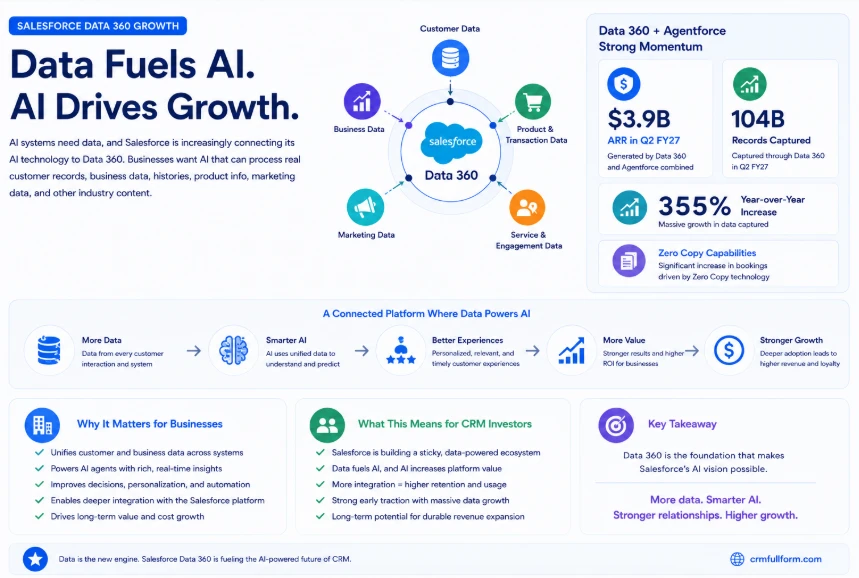
Salesforce reported that Data 360 and Agentforce combined generated about $3.9 billion in ARR in the second quarter of 27 years. The service also reported that Data 360 captured 104 billion pieces of data within the sector, a 355% year-over-year increase, which included a significant increase in bookings generated by its Zero Copy capabilities.
For CRM warehouse businesses, the benefits are simple: Salesforce is trying to build a more connected environment, where data powers AI and AI increases the price of tools that analyze interpersonal relationships. If the technology works, customers should be enabled to integrate more deeply into the Salesforce system, which will likely increase inventory and costs over time.
CRM Stock Valuation
Valuation is where the CRM stock debate gets more interesting. A company could have super products, strong cash flow and promising AI generation even which after all is a bad financing if buyers pay too much for those features. Conversely, a mature tech company experiencing short pessimism may emerge as attractive if the future coin flows are actually worth significantly more than the market price indicates.
At the current available fee of around $264, Salesforce’s trailing P/E ratio was round 23.Five. This is not a really low valuation for a large software agency, but it also no longer usually suggests that CRM is highly priced. Investors will examine a couple of with expected earnings growth, unvested coins waft, working margins, competitive benefits, and the ability of the organization to return capital to shareholders.
Salesforce’s capital-go back strategy is another crucial part of the valuation debate. In FY26, the business returned $14.3 billion to shareholders, which includes $12.7 billion in percentage buybacks and $1.6 billion in dividends. It also authorized a new $50 billion share repurchase program and multiplied its quarterly dividend.
CRM Stock Forecast
The CRM stock forecast should not be considered as a guaranteed guarantee. The share price depends on earnings, luxury fees, financial conditions, investor sentiment, opposition, adoption of AI, and expectations that can change rapidly. Rather than wonder if CRM will actually rise or fall, buyers should be mindful of events that could affect its value over the next few years.
Note that the bullish trend is easy to understand. Salesforce appropriately turns Agentforce into an organizational AI platform, Data 360 adoption continues to accelerate, centralized CRM business products continue to last, live margins robust, and the sales boom accelerates again. In this case, investors may be willing to give more value to CRM because Salesforce can act as a more mature SaaS business, as well as as the first AI infrastructure-and-programs platform.
Bearish condition is exclusive. AI may want to focus on legacy SaaS pricing, customers need to reduce costs for legacy software, competition may want to gain momentum, or the adoption of Agentforce may want to fail at serving up incremental revenue. With increases continuing to hold in the low double digits even as businesses look for the fastest-growing AI services, CRM stock should continue to be below the beaten track even as Salesforce continues to generate significant cash flow.
Is CRM Stock a Good Investment?
Whether CRM inventory is a good investment depends on your time horizon, risk tolerance, portfolio construction, and expectations for Salesforce’s future boom. The organization has several attributes that long-term investors often look for: a large established buyer base, recurring subscriber revenue, strong cash flow, a huge enterprise software ecosystem, and massive investments in AI.
At the same time, Salesforce is no longer a small up-and-coming employer. Its huge sales base means that even successful new products will eventually have to generate billions of dollars in additional revenue to really trade the overall growth premium. Investors will additionally want to recall the possibility of AI changing the economics of agency software faster than Salesforce can adapt.
Modern results harden the bullish argument as management raised FY27 sales guidance citing very rapid Agentforce growth. Still, a sound CRM inventory analysis must distinguish what Salesforce has already accomplished from what investors believe it should achieve in eternity.
CRM Stock vs. Other Software Stocks
Salesforce competes in a market containing some of the world’s largest enterprise technology companies. Depending on the specific product category, investors may compare CRM with Microsoft, Oracle, ServiceNow, Adobe, SAP, HubSpot, and other cloud software businesses. Each company has a different combination of growth, profitability, valuation, AI exposure, and competitive positioning.
One reason CRM stock has attracted renewed attention is that software investors have been debating whether AI will destroy traditional application businesses or make leading platforms more valuable. Recent market action suggests investors are beginning to reward software companies that can demonstrate concrete AI monetization rather than merely announcing AI features. Salesforce’s Agentforce results are therefore important beyond the company itself because they offer investors another data point in the wider AI-versus-SaaS debate.
A direct comparison should therefore go beyond stock-price charts. Investors should examine free cash flow margins, revenue growth, remaining performance obligations, AI-related recurring revenue, customer retention, valuation multiples, and capital allocation before deciding which software stock offers the better risk-reward profile.
Salesforce Competitive Advantages
Salesforce’s biggest competitive advantage may be the ecosystem it has built around customer data and business workflows. Large companies often do not replace core enterprise systems casually because those systems become deeply connected to employees, processes, reporting, integrations, and customer information. This creates switching costs that can provide Salesforce with a significant degree of customer stickiness.
The company also benefits from the breadth of its platform. A customer can potentially use Salesforce for sales, service, marketing, analytics, collaboration, data management, and AI rather than buying completely disconnected products from multiple vendors. The strategic goal is to make these products more valuable when used together.
That ecosystem becomes even more important in an AI environment. If an AI agent needs trustworthy business context to make decisions, Salesforce’s access to customer and operational data could become a competitive asset. The company is clearly trying to build around that concept by combining Agentforce, Data 360, Customer 360, and its broader application portfolio.
Risks of Investing in CRM Stock
CRM stock is not always risky. One of the biggest threats is the disruption of AI itself. Salesforce is investing heavily in AI, yet at the same time enables new competitors to build cheaper or more flexible enterprise software. If groups ultimately need less traditional SaaS services because AI vendors can connect once with data centers and business units, several of Salesforce’s current product categories could face pressure.
Another risk is exploitation. Even after periods of weakness, buyers may also feel that Salesforce delivers high revenue and cash flow growth. If the increase is disappointing, a stock multiple can be established.
The military is another consideration. Microsoft has enormous potential in distribution and AI, although Oracle, ServiceNow, SAP, Adobe, HubSpot, and several emerging AI companies compete for market shares of enterprise software software. So Salesforce needs to embrace the success of its platform while convincing its customers that its AI products deliver measurable enterprise value.
Salesforce Free Cash Flow
Floating free money is one of Salesforce’s most powerful financial stories. Over a 26-year period, Salesforce made $14.Four billion untied cash floating around, that’s sixteen years in 12 months of the year. Operating income reached $15 billion, up 15%.
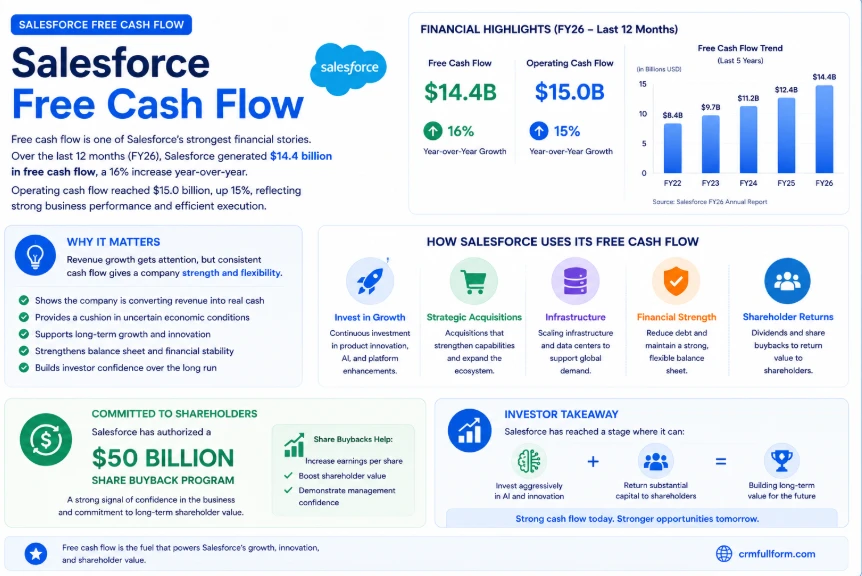
Why is that memorable? Increased revenue attracts attention, but long-term cash flow gives an agency more flexibility. Salesforce can use its cash flow to invest in product improvements, acquisitions, infrastructure, debt monitoring, dividends, and percentage buybacks. Its decision to authorize a $50 billion buyback request shows how seriously management takes shareholder returns.
For long-term investors, this can make CRM the same thing as the businesses of the past that also spend a lot of money. Salesforce has already reached a level where it can simultaneously invest in AI and return huge sums to shareholders.
CRM Stock Dividends and Buybacks
Salesforce is historically often viewed as an addition to the stock market, but its shareholder-return strategy has evolved. The company will now pay dividends and uses a significant percentage of buybacks as part of its capital allocation strategy. In 26 years, Salesforce has returned $14.Three billion dollars to shareholders, with most coming in the form of stock buybacks.
Repurchases can be especially valuable as the company repurchases stock attracting attractive returns by reducing the diversity of shares that represent the acquisition of the business. However, buyers must now not mechanically expect that every repurchase produces a reward. The amount paid for articles of repurchased stock, just as it happens while an investor decides to buy the stock for himself.
The mix of unfastened cash waft, dividends, and buybacks gives CRM stock another measure of pure increase. Investors can view Salesforce not so much as an AI and software program team but also as a mature business that generates enough capital returns.
What Could Drive CRM Stock Higher?
Several catalysts can support the CRM inventory in the future. The first is the sustainable adoption of Agentforce. If Salesforce can prove repeatedly that customers are moving experimental AI marketers out to manufacturing environments, investors can also be more confident in the commercial viability of the company’s AI strategy.
Catalyst 2 is a quick return to sales. Salesforce’s FY27 steerage calls for sales of forty-six billion.1 to forty-six.4 billion, representing 11% to twelve% year-over-year growth. Sustainable growth beyond expectations may want to change the minds of investors.
Catalyst 1/3 of margin growth. Salesforce already costs a lot of money, and driving may want to grow revenue faster than revenue if the company manages costs properly. Share repurchases can also proportionately support earnings by translating into lower pretty share counts.
Finally, more transparency in time series can help. Salesforce’s stock is currently unchanged in isolation; changes in entertainment levels, enthusiasm for AI, corporate IT spending, and sentiment about software teams can all bilaterally influence CRM effectiveness.
What Could Push CRM Stock Lower?
The biggest downside risk is that Salesforce’s growth fails to justify investor expectations. A company can report billions in revenue and still see its stock decline if the market expected even better results. Stock markets price the future, not simply the latest quarter.
Another potential problem is AI-driven pricing pressure. If customers decide that AI allows them to accomplish the same amount of work with fewer software licenses or lower-cost alternatives, Salesforce’s traditional per-user pricing model could face pressure. The company is trying to counter this by developing agent-based products, but the long-term economics are not yet fully established.
Economic weakness could also affect CRM. Large enterprises may delay technology purchases during uncertain economic periods, affecting new bookings and expansion. Currency movements, competition, execution problems, and unexpected changes in AI technology could also influence results.
Should You Buy CRM Stock?
There is no universal answer to whether you should buy CRM stock. For a long-term investor who believes Salesforce can successfully monetize enterprise AI while maintaining its existing customer base and cash-flow strength, the company may offer an attractive combination of growth and financial quality.
For a more cautious investor, waiting for additional evidence may make sense. The key evidence to monitor includes Agentforce ARR growth, total revenue growth, remaining performance obligations, operating margins, free cash flow, customer expansion, and management’s forward guidance. Salesforce’s latest results are encouraging, but investors should remember that rapidly growing AI metrics are still being translated into the economics of a company generating more than $40 billion in annual revenue.
The most useful approach is to build an investment thesis rather than chase a price target. Ask yourself what you believe Salesforce will look like three to five years from now, what assumptions must be true for that outcome, and what could invalidate those assumptions.
CRM Stock Outlook for Investors
The CRM stock outlook has become considerably more interesting following Salesforce’s latest earnings report. The company is showing signs of renewed momentum while simultaneously attempting to transform its position in enterprise software through AI agents and data products. Its FY27 guidance has been raised, while Agentforce has reached a substantial recurring-revenue run rate.
That does not mean Salesforce has eliminated its challenges. Investors still need to watch whether AI revenue remains durable, whether core CRM growth improves, whether margins remain healthy, and whether competitors can develop comparable AI capabilities. The next several quarters should provide increasingly useful evidence.
For people researching CRM stock today, the central investment question is no longer simply whether Salesforce remains a leading CRM provider. It is whether Salesforce can use its enormous customer base, data, applications, and distribution network to become one of the major enterprise AI platforms. If it succeeds, the company’s long-term opportunity could be significantly larger than traditional CRM software alone.
Conclusion
CRM stock refers to Salesforce, Inc. (NYSE: CRM), and the company’s investment story is currently centered on a transition from traditional cloud CRM toward an AI-powered enterprise platform. Salesforce enters this period with considerable strengths, including a huge installed customer base, recurring subscription revenue, strong free cash flow, significant shareholder returns, and a growing portfolio of AI and data products.
Its latest fiscal 2027 second-quarter results provide several reasons for optimism. Salesforce raised its FY27 revenue guidance to $46.1 billion-$46.4 billion, while Agentforce ARR exceeded $1.5 billion and combined Agentforce and Data 360 ARR approached $3.9 billion. Those numbers suggest that AI is beginning to become a meaningful commercial opportunity rather than simply an experimental technology.
Still, investors should approach CRM stock with realistic expectations. Salesforce is already a huge company, competition is intense, and AI could both strengthen and disrupt the traditional SaaS model. The best way to evaluate CRM is to monitor the relationship between revenue growth, AI adoption, profitability, free cash flow, valuation, and shareholder returns rather than focusing on the stock price alone.
FAQs About CRM Stock
1. What does CRM stock stand for?
CRM stock is Salesforce, Inc.’s stock ticker on the New York Stock Exchange. It should not be confused with the general abbreviation CRM, which means customer relationship management.
2. Is CRM the ticker for Salesforce?
Yes. Salesforce trades under the ticker symbol CRM on the NYSE. Salesforce is a major enterprise software company offering CRM applications, data products, collaboration tools, analytics, and AI solutions.
3. What is the CRM stock forecast?
A CRM stock forecast depends on Salesforce’s future revenue growth, earnings, free cash flow, AI adoption, valuation, and broader market conditions. The company currently expects FY27 revenue of approximately $46.1 billion to $46.4 billion.
4. What is driving Salesforce stock?
One of the biggest current drivers is Salesforce’s AI strategy, particularly Agentforce and Data 360. Agentforce ARR exceeded $1.5 billion in Q2 FY27, according to Salesforce.
5. Is CRM stock worth watching?
Yes. Salesforce is worth watching because it combines a large established software business with a potentially significant AI opportunity. Investors should monitor Agentforce growth, revenue guidance, margins, free cash flow, buybacks, and competitive developments before making an investment decision.