
CRM system proficiency means you can do real work inside a CRM without being supervised — create and update records correctly, log every interaction, move deals through the right stages, and pull a report someone else is willing to act on. It is a job-advert phrase, not a certificate, and employers grade it on a scale.
What the phrase actually means
When a job advert asks for CRM system proficiency, it is not asking whether you have heard of customer relationship management. It is asking whether the hiring manager can hand you a login on Monday and stop thinking about it by Friday.
That distinction matters because the phrase has no formal definition. There is no exam, no governing body and no badge. What exists instead is a set of expectations that recruiters carry in their heads, and those expectations are surprisingly consistent across industries. Employers are testing three things: can you enter data that other people can rely on, can you follow the process the business has already agreed, and can you get information back out of the system when someone asks.
It is also a recognised technology skill rather than a soft one. The US Department of Labor’s O*NET database lists customer relationship management software as a named technology skill for customer-facing occupations, alongside specific products such as Salesforce — which is why the phrase turns up in adverts for roles that are not obviously technical, from receptionists to account managers.
If you are still working out what the software itself does before worrying about how well you use it, start with how a CRM works step by step and come back.
The four levels employers score
In practice, hiring managers place candidates on a ladder. Nobody says the levels out loud, but the questions they ask map onto them almost exactly.
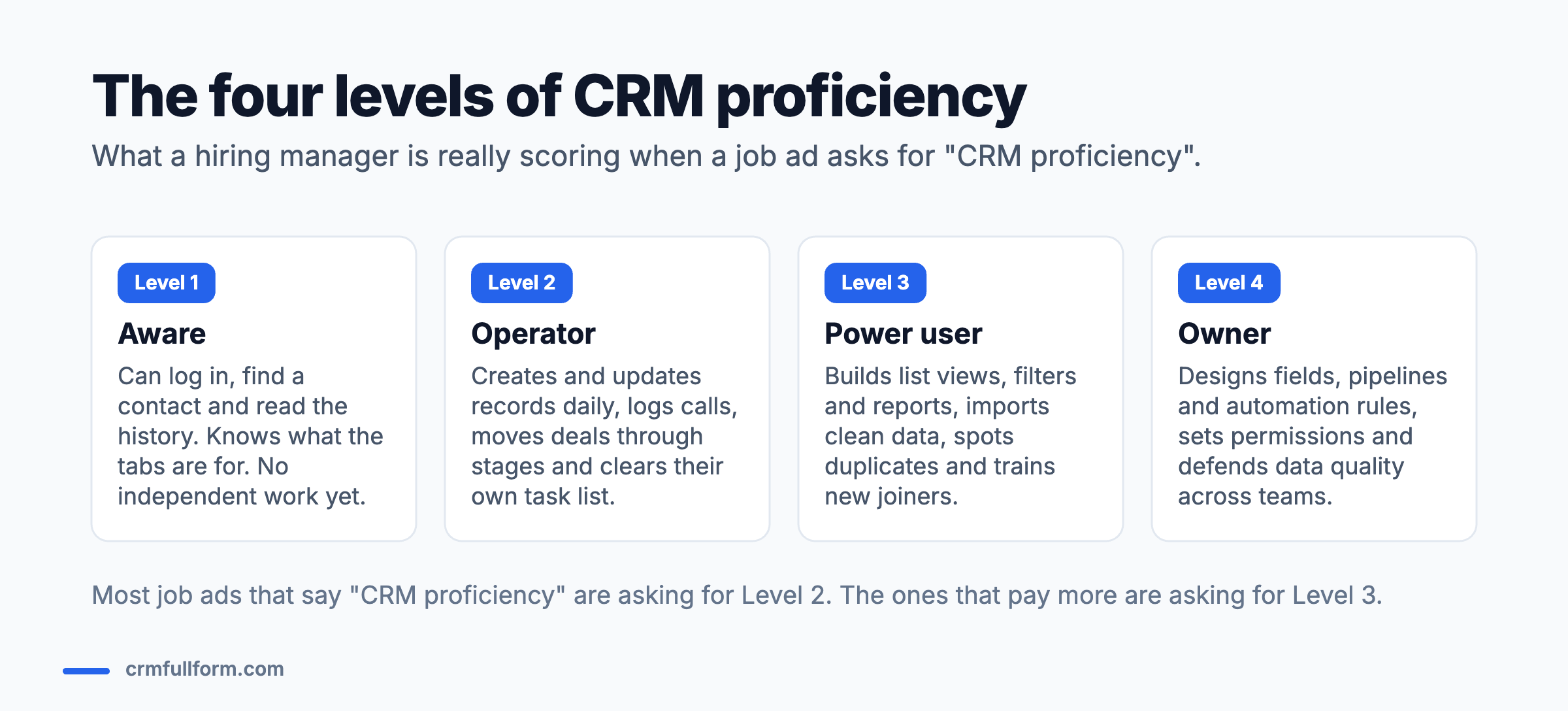
Level 1 — Aware
You can log in, search for a contact and read the history. You know what the tabs are called. This is where most people are after a one-hour demo, and it is not what an advert means by proficient. It is worth listing only if the role is genuinely entry-level and the employer has said they will train you.
Level 2 — Operator
You work in the CRM every day without being reminded. You create leads and contacts with the right fields filled, log calls and emails against the correct record, move deals through the pipeline stages as things change, and clear your own task list. Roughly two-thirds of adverts asking for CRM proficiency mean this level and nothing more.
Level 3 — Power user
You build your own filtered list views, run and interpret reports, import data without creating duplicates, spot when a field is being misused across the team, and show new joiners how the system works. This is the level that separates two candidates on identical salaries, and it is the level worth aiming at.
Level 4 — Owner
You design the fields, the pipeline stages, the automation rules and the permission structure. You decide what gets measured. This is administrator territory and usually a job title of its own — see what a CRM manager does for what that role covers.
What it means in different job adverts
The same underlying requirement gets written half a dozen ways. This table translates the common phrasings into what the employer is checking and what evidence satisfies them.
| If the advert says | What they are really checking | What satisfies it |
|---|---|---|
| “Proficient in CRM software” | Level 2. Can you work in it daily without hand-holding? | A named system and how long you used it every day |
| “Experience with Salesforce, HubSpot or similar” | Whether you can transfer between systems | Concepts you can name: pipeline, lead source, activity log |
| “CRM data hygiene” | Level 3. Do you create mess or clean it up? | A dedupe or data clean-up you actually ran |
| “Ability to generate CRM reports” | Level 3. Can you answer a question with the system? | One report you built and the decision it changed |
| “CRM administration” | Level 4. Can you change how the system behaves? | Fields, workflows or permissions you configured |
The skills sitting behind the phrase
Break proficiency apart and it is four smaller competencies. Most candidates have one or two and assume that covers it.
Data discipline
- Entering a record once, in the right place, with the source recorded
- Recognising a duplicate before creating one
- Knowing which fields are mandatory for a reason and which are decoration
- Understanding that a blank field and a wrong field are different problems
Process discipline
- Moving a deal to the stage it is genuinely at, not the stage you wish it was at
- Logging the activity on the day it happened
- Setting a dated next action instead of relying on memory
- Following the routing and ownership rules the team agreed
Reporting
- Filtering a list view to answer a specific question
- Reading a pipeline report and saying what it implies
- Knowing when a number looks wrong and why it might be wrong
Judgement — the one nobody lists
The most valuable thing a proficient user does is notice when the system and reality have drifted apart, and say so. Anyone can tick boxes. Someone who tells a manager “half these deals have not been touched in six weeks, our forecast is fiction” is demonstrating the skill the advert was actually reaching for.
How to write it on your CV
The word “proficient” on its own carries no information, because everybody writes it. Replace the claim with evidence: name the system, state the scale, and give one outcome.
Weak: “Proficient in CRM systems.”
Better: “Used Zoho CRM daily for 18 months managing roughly 60 open opportunities; built the weekly pipeline report used in the Monday sales meeting.”
Three more patterns that work, adapt them to your own numbers:
- “Managed around 400 contact records in HubSpot; ran a de-duplication that removed 1,100 duplicates before a campaign send.”
- “Logged and dispositioned 40–60 calls a day in Salesforce Service Cloud, maintaining first-contact resolution above the team average.”
- “Set up the lead-source fields and reporting in a free CRM for a family business, so enquiries could be traced back to the advert that produced them.”
If you have no paid experience yet, the last example is the honest version and it still scores. Employers care far more that you understand what a lead source is for than where you learned it.
Build real proficiency in 30 days
You do not need an employer to reach Level 2, and you can get close to Level 3. Every major vendor offers a free tier that is a genuine, working CRM rather than a demo.
- Week 1 — vocabulary. Learn the object model: contact, company, deal, activity, ticket. Read the types of CRM and the standard features so you can talk about a system you have not used.
- Week 2 — enter data. Open a free account (Zoho, HubSpot and Bitrix24 all offer one — see the CRM software comparison). Invent 40 contacts and 15 deals. Fill every field. Notice which ones you resent filling in; those are the ones real users leave blank.
- Week 3 — run the process. Move deals through stages over several days, log calls and notes with real dates, set follow-up tasks and actually clear them. This is what creates the muscle memory an interviewer can hear.
- Week 4 — report and break things. Build three list views and two reports. Import a messy CSV on purpose and clean up the duplicates it creates. Then write down, in two sentences, what your pipeline report says. That sentence is your interview answer.
There is a longer version of this plan in our free roadmap for learning CRM.
How it gets checked at interview
Almost nobody is asked to log in and demonstrate. Instead the check is conversational, and it is easy to pass if you have done the work and very hard to fake.
- Naming. “Which CRM have you used?” Vague answers here end the topic badly.
- Scale. “Roughly how many records or deals were you handling?” Real users know their rough numbers.
- Process. “Walk me through what happens when a new enquiry arrives.” This is the question that separates Level 1 from Level 2.
- Failure. “What did people get wrong in your CRM?” Only real users have an opinion, and it is usually about duplicates or stale deals.
- Reporting. “How would you find out which channel produced the most closed business last quarter?”
Our list of CRM interview questions and answers covers these in detail, including the software-specific ones.
Frequently asked questions
What is CRM system proficiency?
CRM system proficiency is the ability to work independently inside a customer relationship management system: creating and updating records accurately, logging every interaction, moving deals through the correct pipeline stages, and producing reports that other people can act on. It is judged on a scale rather than passed or failed, and no certificate is required.
What does “CRM skills” mean on a job description?
It usually means daily operational use rather than administration. The employer wants someone who will keep records complete and current, follow the agreed sales or service process inside the system, and be able to pull a list or a report when asked. Only adverts that say “administration” or “configuration” are asking for system-building skills.
Do I need a CRM certification to be considered proficient?
No. Certifications such as Salesforce Administrator or HubSpot certifications help for specialist roles and are free or low cost for the entry-level ones, but most employers accept demonstrated daily use instead. Naming a system, stating the scale you worked at and describing one report you built carries more weight than a badge with no story attached.
How do you list CRM skills on a CV or resume?
Replace the word “proficient” with evidence. Name the specific system, say how long and how intensively you used it, and give one measurable outcome — for example the number of records you maintained, a de-duplication you ran, or a report that went into a regular meeting. Generic claims are ignored because every candidate makes them.
How long does it take to become proficient in a CRM?
Reaching everyday operator level takes most people two to four weeks of genuine daily use, because the concepts transfer between systems even when the buttons move. Reaching power-user level — reports, imports, data clean-up and training others — usually takes three to six months of real work rather than practice.
Related pages
- CRM full form — what the letters stand for and why the term exists
- What is a CRM executive? — the entry-level job this skill leads to
- What is a CRM manager? — the role above it
- How to learn CRM — the free roadmap in full
- CRM interview questions — 25 questions with answers
- Best CRM software — free tiers you can practise on