
A CRM manager owns the customer database and the processes that run on top of it. They decide what gets recorded, design the pipeline stages and automation, build the reports leadership uses, and spend a surprising amount of time persuading sales and service teams to actually use the system. It is a process job, not a software job.
What a CRM manager actually does
Job titles in this space are vague, so start with the work rather than the label. Strip out the company-specific detail from almost any CRM manager job description and six responsibilities remain.
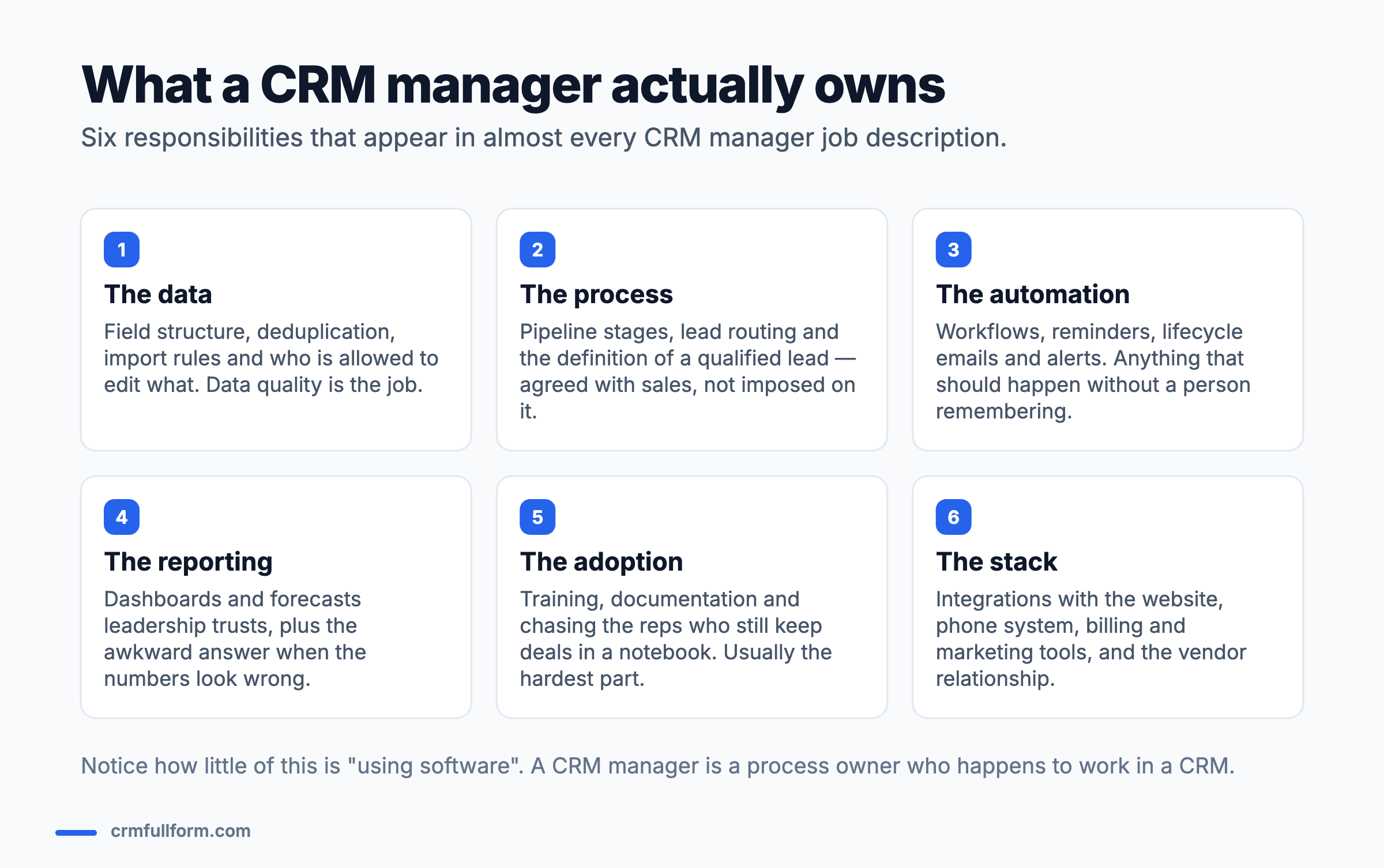
Notice how little of that list is “using software”. Configuring a workflow in Salesforce or HubSpot takes an afternoon to learn. Deciding which workflow the business needs, getting sales and marketing to agree what a qualified lead is, and then defending that definition six months later when the numbers get awkward — that is the job.
There are two broad flavours of the role, and they attract different people:
- Marketing-side CRM manager. Owns the customer lifecycle: segmentation, email and lifecycle campaigns, retention, churn and loyalty. Common in e-commerce, gaming, subscription and retail businesses. Often sits under a marketing director.
- Sales-operations CRM manager. Owns the pipeline, forecasting accuracy, territory and routing rules, and integration with billing. Common in B2B and SaaS. Often sits under a revenue-operations or sales-operations lead.
The advert will rarely say which one it is. The tell is in the responsibilities: if it mentions campaigns, segments and churn, it is the first. If it mentions forecasting, pipeline hygiene and territories, it is the second.
A realistic week in the role
Job descriptions describe strategy. Actual weeks look more like this, and it is worth knowing before you apply.
- Roughly a third of the week is data. Duplicates, imports that went wrong, records with no owner, deals that have not moved since March.
- A quarter is reporting. Building or fixing a CRM dashboard, then explaining to someone why their number and your number differ.
- A quarter is people. Training, chasing, writing documentation nobody reads, and negotiating with a sales manager who wants one more mandatory field.
- The rest is building. Workflows, integrations, a new pipeline for a new product line, a vendor call about licences.
The reason data takes so long is that a CRM is a legal record as well as a sales tool. Under UK GDPR, personal data has to be accurate and kept up to date where that matters — which makes routine record maintenance a compliance task rather than housekeeping.
CRM manager salary
Salary varies more than most roles because the same title covers a marketing executive with two years’ experience and a revenue-operations lead running a seven-figure Salesforce estate. Two independent datasets give a reasonable picture.
| Market | What the data shows | Source and date |
|---|---|---|
| United Kingdom | Median advertised salary of £64,750, across 112 job adverts | IT Jobs Watch, six months to 26 August 2026 |
| United States | Average base of $103,929, with a range of $68,031 to $158,768 | Indeed, 357 job postings, updated 19 July 2026 |
| India | Typically ₹8–20 lakh per year, with the upper half concentrated in SaaS and fintech | Indicative range from advertised roles |
| Entry to the role | Usually a step up from CRM executive rather than a first job | Observed across job adverts |
Two patterns are worth knowing. First, the spread within a market is wider than the gap between markets — a London CRM manager at a small e-commerce brand and one at a bank can be £30,000 apart. Second, the biggest single lever on pay is not years of experience but whether you own the reporting that leadership makes decisions from. People who are asked into the forecast meeting get paid differently from people who are asked to fix the data before it.
Skills and tools that matter
The skills adverts ask for
- Data literacy. Segmentation, deduplication, import mapping, and enough SQL or spreadsheet skill to check a number independently.
- Process design. Turning a messy real-world sales or service process into stages, owners and rules that survive contact with the team.
- Reporting. Building dashboards people trust, and knowing which metric answers which question.
- Automation. Workflows, triggers, lifecycle emails, and the judgement to know when automating something makes it worse.
- Stakeholder management. The unglamorous core of the job. You will be changing how other people work.
The tools
Salesforce and HubSpot dominate the adverts, with Microsoft Dynamics 365, Zoho, Braze, Klaviyo and Iterable appearing depending on the flavour of the role. Do not over-index on the specific platform: the concepts transfer, and hiring managers know it. What matters is that you can name a system, describe how you configured it and say what changed as a result. Our comparison of the best CRM software covers what each is genuinely strong at, and what Salesforce CRM is if that is the one on the advert.
Manager vs executive vs administrator
These three titles overlap constantly and the boundaries move by company size. As a rough guide:
| Title | Centre of gravity | Decides what? |
|---|---|---|
| CRM executive | Doing the work inside the system — campaigns, records, lists | Very little; executes an agreed plan |
| CRM manager | Owning the process, the data model and the reporting | What gets measured and how the process runs |
| CRM administrator | Technical configuration, security, releases, integrations | How the platform is built and kept stable |
| Head of CRM / RevOps | Strategy, budget, vendor selection, team | What the business invests in |
In a company of thirty people all four are one person. In a company of three thousand they are four teams. If you are earlier in the ladder, CRM system proficiency explains what employers score before you get near a manager title.
How to become a CRM manager
There is no single route, but three are common and one of them is much faster than people expect.
- From CRM or marketing executive. The standard path. Two to four years operating the system, then take ownership of one reporting area and one process. That ownership, not the tenure, is what makes the promotion case.
- From sales operations or sales. Common in B2B. You already understand pipeline and forecasting; you need to add data and automation skills.
- From analytics or data. Increasingly common. You already have the reporting half and can learn the process half on the job — this is often the fastest route in.
Whichever route you take, the portfolio is the same three things: a process you redesigned, a data problem you fixed with numbers attached, and a report that changed a decision. Vendor certifications (Salesforce Administrator, HubSpot) help you get past screening but do not substitute for those three. If you are starting from zero, our free roadmap for learning CRM is the place to begin, and how CRM works covers the mechanics you will be managing.
Is it a good job?
Honestly, it depends on your tolerance for one specific frustration. The upside is real: it pays above the marketing average, the skills transfer across every industry, demand is steady because every company that sells anything eventually needs one, and you sit close to the numbers leadership cares about, which is good for a career.
The downside is that you are accountable for data other people enter. You will build something sensible and watch it decay because a team under quota pressure stopped filling in a field. People who enjoy the role treat that as the interesting part — a design and influence problem. People who leave the role usually leave because of it.
Frequently asked questions
How much does a CRM manager earn?
In the UK, IT Jobs Watch put the median advertised salary at £64,750 across 112 adverts in the six months to 26 August 2026. In the United States, Indeed reported an average base of $103,929 from 357 job postings as of July 2026, with a range from about $68,000 to $159,000. In India, advertised roles typically fall between ₹8 and ₹20 lakh a year.
Is a CRM manager a good job?
For most people, yes. It pays above the marketing average, the skills transfer to any industry that sells something, and demand is stable. The main frustration is that you are held accountable for data quality that depends on other teams entering information properly, so the role suits people who enjoy influencing how others work.
Is CRM an IT job?
Usually not. A CRM manager normally sits in marketing, sales operations or revenue operations rather than IT, and the work is process design, reporting and adoption rather than engineering. The exception is the CRM administrator or developer role, which is genuinely technical and often does report into IT.
Is CRM difficult to learn?
The software is not difficult — most people are operating a CRM competently within a few weeks. What takes longer is the judgement: knowing which process to model, which fields are worth making mandatory, and how to design reports that answer real questions. That part typically takes months of real work rather than study.
What qualifications do you need to be a CRM manager?
No specific degree is required and most adverts do not name one. Employers look for demonstrated ownership: a process you designed, a data problem you fixed and a report that changed a decision. Vendor certifications such as Salesforce Administrator help you pass screening but rarely decide the hire on their own.
Related pages
- CRM full form — what customer relationship management means
- What is a CRM executive? — the role one step below
- What is CRM system proficiency? — how CRM skill is scored
- What is a CRM dashboard? — the reporting side of the job
- CRM interview questions — 25 questions with answers
- Best CRM software — the platforms you will be asked about